
Click to join the conversation with over 500,000 Pentecostal believers and scholars
Stan Wayne | PentecostalTheology.com
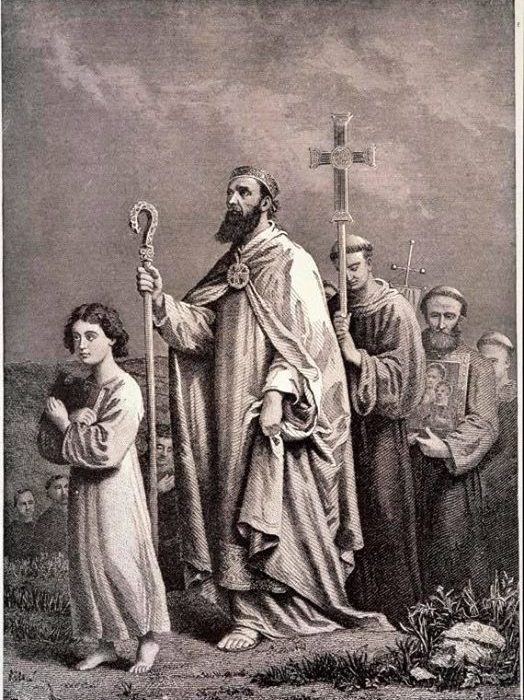
Read to the end to see if Patrick was Pentecostal
“A few years later I was again with my parents in Britain. They welcomed me as a son, and they pleaded with me that, after all the many tribulations I had undergone, I should never leave them again. It was while I was there that I saw, in a vision in the night, a man[Nota] whose name was Victoricus coming as it were from Ireland with so many letters they could not be counted. He gave me one of these, and I read the beginning of the letter, the voice of the Irish people. While I was reading out the beginning of the letter, I thought I heard at that moment the voice of those who were beside the wood of Voclut, near the western sea[Nota]. They called out as it were with one voice: “We beg you, holy boy, to come and walk again among us.” This touched my heart deeply, and I could not read any further; I woke up then. Thanks be to God, after many years the Lord granted them what they were calling for.
24
Another night – I do not know, God knows, whether it was within me or beside me[Nota] – I heard authoritative words which I could hear but not understand, until at the end of the speech it became clear: “The one who gave his life for you, he it is who speaks in you”; and I awoke full of joy.
25
Another time, I saw in me one who was praying. It was as if I were inside my body, and I heard above me, that is, above my inner self. He prayed strongly, with sighs. I was amazed and astonished, and pondered who it was who prayed in me; but at the end of the prayer, it was clear that it was the Spirit. At this I awoke, and I remembered the apostle saying: “The Spirit helps the weaknesses of our prayer; for we do know what it is we should pray, but the very Spirit pleads for us with unspeakable sighs, which cannot be expressed in words[Nota].” And again: “The Lord is our advocate, and pleads for us[Nota].”
26

Varnel Watson
The original snake handler 🙂 http://www.pentecostaltheology.com/for-all-the-snake-handlers-out-here-st-patrick-left-none/
Link Hudson
No clear references to tongues there, bot Patrick was no cessatioñist. He was known for healing and raising the dead .
Stan Wayne
I would say “unspeakable sighs” is close enough
Varnel Watson
I would not say that
Stan Wayne
Don’t know about Patrick for sure but I think Paul is referring to tongues there
Varnel Watson
So was he Pentecostal ?
Varnel Watson
Stan Wayne The Spirit helps the weaknesses of our prayer; for we do know what it is we should pray, but the very Spirit pleads for us with unspeakable sighs, which cannot be expressed in words
Stan Wayne
Maybe
Varnel Watson
Maybe Timothy K. Wiebe can take him to the movies sometimes 🙂
Stan Wayne
Dean Henry Alford always insightful:
groanings which cannot be expressed:—i.e. the Holy Spirit of God dwelling in us, knowing our wants better than we, Himself pleads in our prayers, raising us to higher and holier desires than we can express in words, which can only find utterance in sighings and aspirations: see next verse. So De W., Thol., Olsh. Chrys. (Hom, xiv., p. 586) interprets it of the χάρισμα of prayer—and adds ὁ γὰρ τοιαύτης καταξιωθεὶς χάριτος, ἑστὼς μετὰ πολλῆς τῆς κατανύξεως
similarly Œc(54) and Theophyl. Calv. understands, that the Spirit suggests to us the proper words of acceptable prayer, which would otherwise have been unutterable by us: and similarly Beza, Grot.
ἀλαλήτοις may bear three meanings—1, unspoken: 2, that does not speak,—mute (see LXX, Job 38:14; Sirach 18:33 compl.): 3, that cannot be spoken. The analogy of verbals in – τος in the N. T. favours the latter meaning: compare ἀνεκδιήγητος, 2 Corinthians 9:15,— ἄῤῥητος, 2 Corinthians 12:4,— ἀνεκλάλητος, 1 Peter 1:8 (Thol.).
in nobis gemit, quia gemere nos facit.’ No intercession in heaven is here spoken of, but a pleading in us by the indwelling Spirit, of a nature above our comprehension and utterance
Varnel Watson
William DeArteaga was St Patrick an anglican roman Pentecostal ?
William DeArteaga
YES,but he would not use that vocabulary.
Varnel Watson
in that case he reminds me of Philip Williams 🙂
Link Hudson
There are historians who accept two documents as coming from him. If I recall correctly, the account of his seeing a vision that instructed him to escape from Ireland and the account of the supernatural voice that led him to go back to minister are both from his own writings. Having visions and hearing supernatural voices are in line with Pentecosotal beliefs, generally.
There are writings a generation or two after he passed away that tell of his performing a great number of healings, including raising a number of people from the dead and even one horse.
There are things that are not culturally ‘Pentecostal’ about the story of Patrick. For one thing, he confessed his sin to a fellow priest/elder who blabbed of his shameful sin of his youth, something that he was quite ashamed of, but that we do not know about. Patrick had some conflict with the church establishment in Briton. There was probably some jealousy over his great success in Ireland, and he wrote a scathing letter wanting bishops to excommunicate kings who were capturing Christians and selling them off into slavery, if I recall correctly. On one occasion, his sin was published.
Confessing sins to an elder is more a Roman Catholic practice than a Pentecostal one.
Patrick was also a monk, apparently. He established monastaries that would later become both centers for learning and centers for expansion of the gospel. The existence of celibate believers dedicated to living a celibate life to glorify God is not antithetical to the Bible, though it is not really a part of Pentecostal culture or tradition.
Varnel Watson
which are those historians and what documents?
Link Hudson
Troy Day You can look it up yourself. I think there are just two.
Varnel Watson
which ones should I be looking for namely ? Have you mention them before. Can you pass the Link pls
Link Hudson
Troy Day Confessio and Letter to the Soldiers of Coroticus. Check Wikipedia for links.
Varnel Watson
if you are still referring to his Confessio and Epistola I read them many years ago in my program in Dublin in their original However, which part from this letters do you see relevant to OP? Their authorship has been questioned BTW
Troy Day
Neil Steven Lawrence Oscar Valdez @highlight Philip Williams https://www.msn.com/en-us/news/us/god-doesn-t-exist-america-s-most-atheist-states-ranked/ss-BB1jSB1o?ocid=msedgntp&pc=U531&cvid=7571297a8f5a4541a73c9a6dc19c993d&ei=5