

Click to join the conversation with over 500,000 Pentecostal believers and scholars
| PentecostalTheology.com
Would Society for Pentecostal Studies consider releasing FREE all annual publications of Pentecostal scholarly papers from JStor so people around the world can read them for free online, especially where they cannot afford paying for them?
 We can help with broadcasting them to the web:
PentecostalTheology.com
- 5000 Pentecostal members
- 4000+ articles and going strong
- Daily scholarly discussions
- And much more…


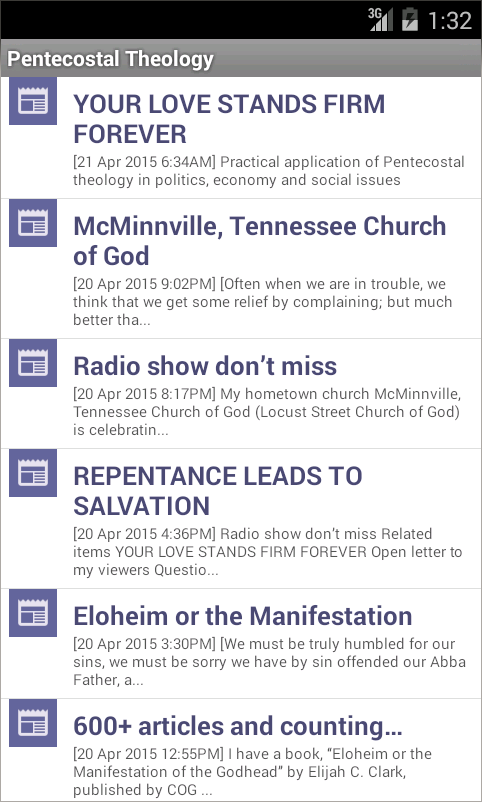
PENTECOSTAL THEOLOGY PHONE APP
The app helps you keep up with important news updates and Pentecostal discussions directly on your phone. Get with the program, people – it’s the 21st century!
Download here: https://play.google.com/store/apps/details?id=pentecostaltheology.com
REACH MILLIONS WITH YOUR MESSAGE
1. Join the Pentecostal group on Facebook: https://www.facebook.com/groups/pentecostaltheologygroup/
2. Post your topic in the group
3. We will publish it automatically via http://www.pentecostaltheology.com/
Easy enough? CLICK TO START NOW
A good Bibliography in Pentecostal/Charismatic Theology
History Bartleman Frank Azusa Street (Bridge Publishing NJ. 1980) Dayton Donald. Theological Roots of Pentecostalism (Hendrickson Publishers, Peabody Mass, 1994)
The Largest and Most Complete Bibliography on the Pentecostal Charismatic Movement
Albrecht, Daniel E. Rites in the Spirit: A Ritual Approach to Pentecostal/Charismatic Spirituality. Journal of Pentecostal Theology Supplement Series 17. Sheffield, UK: Sheffield
Pentecostalism: Advanced Information
Pentecostalism is an evangelical charismatic reformation movement which usually traces its roots to an outbreak of tongue – speaking in Topeka, Kansas, in 1901
The gift of tongues in relation to prayer
Is there anyone here that can direct me to a good, theologically based with good Scripture references and exegesis of the texts
A Complete List of Theological Schools, Colleges and Seminaries for Pentecostal Students and Scholars
Complete List of Pentecostal Theological Schools, Colleges and Seminaries with their full addresses, contact information, social media profiles and average cost per credit hour

Varnel Watson
Amen there Daniel Rushing Michael Ellis Carter Jr. William DeArteaga Millions Pentecostals worldwide can benefit from fine scholarship and we can help the papers be made available for free
Dave Ketter
If you mean those papers from the annual meeting, they can’t because the copyrights are held by their authors. And their Brill contract might prevent doing that with Pneuma articles.
Varnel Watson
Dave Ketter William DeArteaga Surely most of these have expired and could be negotiated. After all, 99% of printed periodicals in America have been freely offered online Why hold on to scholarly resources that can help millions Pentecostals and theologians worldwide and Make Theology Great Again? https://app.box.com/s/p6p7jd4w4l5tonzejtj51ozdgxuv4fir
Dave Ketter
Copyrights don’t expire until 70 years after the life of the author.
Dan Irving
The very notion of copyrighted “Pentecostal” material is chilling.
Dave Ketter
Not for nothing; but I’d like the ability to put mine into a larger book that is more readily available and accessible to people.
Dan Irving
If the information and insights came through natural/wordly means, then I would agree, yes, there is a proprietary interest in them. If they came from the Spirit of God, withholding them would seem contrary to Christ’s commandment, “Freely ye have received, freely give.” I suppose each of us must decide whether what we have received was by the Spirit or by academic efforts.
Varnel Watson
Publishing costs are high and must be covered somehow. No argument there. But once they are covered there is no problem to make the papers free for all to read. Furthermore, most papers presented come with membership dues anyway. Making even some papers free would promote the magazine and bring more readers. In global Pentecostalism context where this could mean millions the idea is worth at least some consideration. Other publishers have long done it with great success and avid returns
Dan Irving
High? It’s as cheap as pushing a button on one’s keyboard.
A.J. Bible
Dan Irving, how many books have you published?
Varnel Watson
A.J. Bible These are not books but research papers presented upon one’s paid membership ie costs covered by author. As part of this process they are all already posted on the internet It is a matter of allowing free access. I’ve authored over two dozen books and have made them available on Kindle where possible. This group has also helped several Pentecostal foundations publish and promote their scholarly research at virtually no charge. We can do the same for Dake Publishers as many resources from Dake Bible are already circulating free on the internet
Varnel Watson
Dave Ketter No argument against copyright. But for digital online version copyright could be negotiated to 25 yrs as well
No one is saying make it all free, but if its 25 yrs old (SPS started 1982) make it free for all to read – what could be that big of a deal?
I know 2 dozen SPS authors in this group alone that will GLADLY release personal copyrights to make their papers free to read to Pentecostals globally – isnt our mandate to reach the whole world anyway? And we can help. We’ve done it before with other Pentecostal publishers. Nothing to lose. There’s only something to gain for global Pentecostalism and it is at least worth some consideration and perhaps voting as agenda item in the business meeting William DeArteaga Daniel Rushing Michael Ellis Carter Jr.
Michael Ellis Carter Jr.
I agree with you Troy Day this could help us shape the future of Pentecostals globally.
Varnel Watson
Overall this is not a small issue. Imagine the gain for Pentecostal scholars, students, pastors, churches and general readers SPS papers 25 yrs and older are released this year alone. That means a decade long of Pentecostal scholarship 1982-1990 – basically the 80s most crucial for the establishing of the 70s Charismatic churches and the baby boomers as Pentecostal wing in America alone not to mention the rise of the 3rd wavers and the overall research for Classical Pentecostalism right there while establishing its doctrine as a filed in academia.
Varnel Watson
William DeArteaga Overall this is not a small issue. Imagine the gain for Pentecostal scholars, students, pastors, churches and general readers SPS papers 25 yrs and older are released this year alone. That means a decade long of Pentecostal scholarship 1982-1990 – basically the 80s most crucial for the establishing of the 70s Charismatic churches and the baby boomers as Pentecostal wing in America alone not to mention the rise of the 3rd wavers and the overall research for Classical Pentecostalism right there while establishing its doctrine as a filed in academia.
This is not a small issue to consider Dave Ketter Just think about the global effect on Pentecostals worldwide. Reach to all SPS members talking in this group to offer words of wisdom and appropriate action. Daniel Rushing <— the force is strong with this one…
Varnel Watson
William DeArteaga Daniel Rushing Jon Ruthven Joseph Kidwell Dave Ketter
With over 20 politically loaded topics that I just counted in the program (there is probably many more) it is still quite surprising SPS dos not have political theology yet. Wonder why? sps-usa.org
1. WTS THEME: BORDERS: BANE OR BLESSING?
2. Recent political, economic, and social events, from immigration issues coming to the fore in the Brexit vote and the USA presidential election to relentless terrorist attacks across national borders
3. Christian Ethics—Panel Discussion: “Pentecostalism and Trump’s America”
4. Decolonizing Identity Politics
5. London School of Theology, “A Task for the Anointing: Human Flourishing From a Pentecostal Perspective in the Trumpian Epoch
6. Identity/Politics: Jean-Luc Nancy and the Falleness of identity
7. A Wesleyan Means of Moral and Political Formation
8. Boundaries are not Borders – A Narrative Exploration of Immigration
9. “Borders, Habitations, Foreigners, and Strangers: Mary Bosanquet Fletcher’s Metaphors for an Expanding and Inclusive Gospel Ministry from the Margins”
10. Human Right Versus Human Rights
11. Keynote Address: “Breaking Borders & Boundaries Through Technology in a Digital Age,”
12. Are some borders necessary to the establishment of the kingdom of God? If so, what are they?
13. Are there borders which should separate Christians from people of other faiths?
14. Constructing Borders of Legitimacy and the Assimilation of Ethnics
15. Beyond Borders: A Relationship of Love with a Syrian Refugee Family
16. Complementarianism: Borders in Bodies
17. Segregation and Real-Estate Covenants in Kansas City
18. The Joseph Dilemma: Spiritual Advisers and the Burden of Political Access
19. By My Spirit: Divine and Human Agency in the Transformation of Sociopolitical Realities
20. Defending Borders & Godly Nationalism
Dave Ketter
It’s worth pointing out that many of these papers listed are actually WTS (Wesleyan Theological Society). SPS has some. But not to the degree that WTS has this year.
That said, there’s a process for setting up an interest group and anyone can engage that. If it garners interest among conference attendees, it will be added. The President said as much on another interest group possibility yesterday.
Varnel Watson
True for the LGBT papers too, hence WTS theme posted @ the start of the list Still a political theology group seems to be missing for both parties in this joint meeting
Varnel Watson
William DeArteaga Is it possible that we have approach this the wrong way? Instead of asking SPS we should have asked SPS presenters to publish papers in the group for all of us to learn Daniel Rushing Dave Ketter Dan Irving
Dan Irving
Hmmm . . Sounds like just a lot of SJW stuff.
Varnel Watson
well still I think we may have approached it differently
Varnel Watson
They probably wouldnt Michael Ellis Carter Jr.
Michael Ellis Carter Jr.
Troy Day I agree they probably wouldn’t. I can’t get them from places I pay to have access lol ?
Varnel Watson
If you are a member you can still get them annually BUT its not like they are for sale any other venue so why not make them free? Especially the ones from 70-80s
Varnel Watson
do you think they will ever do it? Francisco Arriola