
Click to join the conversation with over 500,000 Pentecostal believers and scholars
| PentecostalTheology.com
William Seymour’s thoughts turned to marriage. Jennie Evans Moore, a faithful member of his ministry in Los Angeles, became his wife. She was known for her beauty, musical talents, and spiritual sensitivity. She was a very gentle woman and was always faithful to stand beside Seymour. It was Jennie who felt the Lord would have them marry, and Seymour agreed. The couple married on May 13, 1908. After the ceremony, William and Jennie moved into a modest apartment upstairs in the Azusa Mission.
But the news of their marriage angered a small yet very influential group at the Mission. One of the main antagonists was Clara Lum, the mission’s secretary responsible for the newspaper’s publication. After learning of Seymour’s marriage, she abruptly decided that it was time to leave the mission.
A few believers at Azusa had some very odd ideas about marriage. Lum’s group believed marriage in the last days to be a disgrace because of the coming return of Christ, and they severely denounced Seymour for his decision.
It may have been that Clara Lum was secretly in love with Seymour and that she left because of her jealousy. Whatever the reason, she relocated to Portland, Oregon, to join the mission headed by a former Azusa associate, Florence Crawford. When she did, she took the entire national and international mailing lists with her.
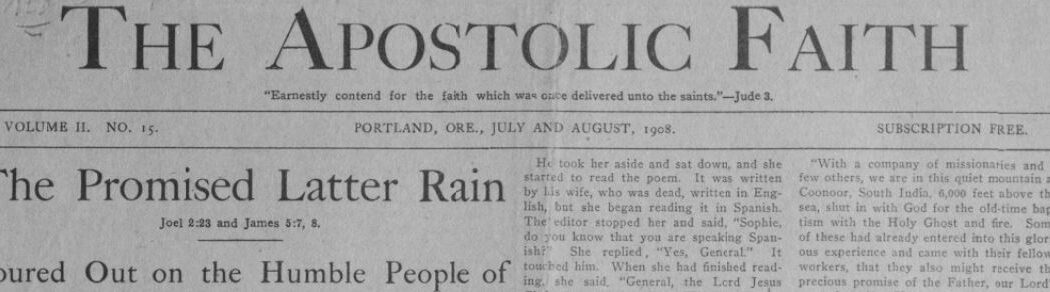
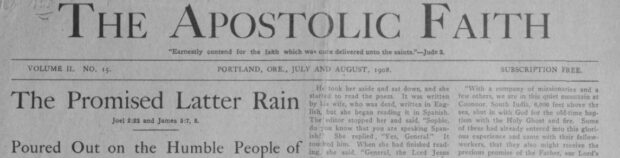
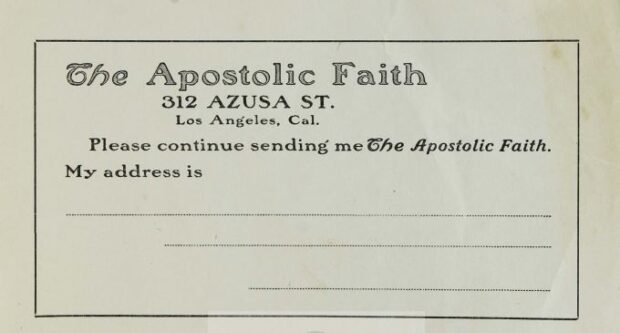
This unthinkable action crippled Seymour’s worldwide publication outreach. His entire national and international lists of over fifty thousand names had been stolen, leaving him with only the Los Angeles list. Then, when the May 1908 Apostolic Faith was sent out, the cover looked the same, but inside was a column announcing its new address in Portland for contributions and mail. The thousands who eagerly read and sent contributions to the newspaper now started sending them to Portland without questioning the change. By the June issue, no article by Seymour appeared at all. Finally, by midsummer of 1908, all references to Los Angeles were omitted entirely. When it became clear that Lum wouldn’t be returning, the Seymours traveled to Portland to confront Lum and ask for the lists. But the lists were never returned.
Without this vital information, it was impossible for Seymour to continue the publication, and an era of Azusa was brought to a dramatic end.
At first Clara Lum answered some of the letters, but she could not keep up even though she probably had some help, so they followed Parham’s example and published a paper which would be used in place of answering multitudes of personal letters. To avoid confusion with Parham’s Apostolic Faith paper it would be published by, “The Apostolic Faith Movement of Los Angeles,” but still called “The Apostolic Faith.” Many people speculate that Seymour was editor of that paper, and some have even said it was so, but we can easily determine that he was not. For one thing, the paper had a stated policy that no editorial credit would be given. This seems a little strange because almost every other article in the papers was credited. If you wrote a letter, gave a testimony, preached a sermon, wrote an article, or told of an event, your name appeared below the article. It seems that only editorial statements were unsigned. However if we read the first editorial, appearing on page one, columns one and two, of the first issue of the paper, it becomes obvious that Seymour did not write it. Bearing the banner headline, “Pentecost Has Come.” in the second half of the second paragraph it proceeded to say, “The writer attended a few of these meetings and being so different from anything he had seen and not hearing any speaking in tongues, he branded the teaching as third-blessing heresy, and thought that settled it. It is needless to say the writer was compelled to do a great deal of apologizing and humbling himself to get right with God.” This wording rules out Seymour and all female persons as the writer of that editorial. On examination, not one unsigned editorial can be directly attributed to Seymour, but his sermons and answers to direct questions were always signed.
It is in no way a criticism of Seymour that he did not edit the paper. Consider that Ernest Williams was elected general superintendent of the Assemblies of God in 1929 and held that position for about twenty years. At no time during those years was he the editor of the official church paper. Consider also Joseph King, elected general superintendent of the Pentecostal Holiness Church in 1917. In his memoirs he tells how he ceased from editorial duties when he was elected general superintendent. It is OK that Seymour was not the editor of the “The Apostolic Faith.” That distracts nothing from him, but more importantly, it is the evident truth.


Troy Day
quite the important for @highlight all our @followers John Mushenhouse Dan Cross Dan Irving Roscoe Barnes III David Bundy Jose Salinas Neil Steven Lawrence
Dan Irving
Troy Day More treacherous was the doctrine they promulgated (from Portland.)
Troy Day
Dan Irving tell us all about it – this is a great discussion indeed Philip Williams John Mushenhouse David Bundy
Dan Irving
Troy Day I’m currently writing a book on the subject of pneumatology, and the Pentecostal 2nd Work doctrine factors heavily. This was a doctrine that essentially denied the legitimacy of the Holy Spirit’s Baptism for any who could not attest to a prerequisite experience as defined by Wesleyan Holiness teaching. The doctrine was particularly severe in this case, because they also promoted the “Eradication” doctrine that was so controversial in 19th Century Holiness teaching. Essentially, this charged as “counterfeit” anyone’s baptism not preceded by the “eradication” of sin in the recipient/convert.
Dan Irving
It led to a lot of pseudo-holiness, denial of reality, and hard legalism, and worse things.
Troy Day
Dan Irving Pentecostal 2nd Work doctrine factors heavily – you mean ENTIRE sanctification? Both fractions believed in 2nd work not finished work
Dan Irving
The Wesleyan 2nd work was powerful teaching that drove many revivals of religion in the 18th and 19th Centuries. The early Pentecostal handling of the doctrine was disastrous.
John Mushenhouse
Dan Irving how so –
Troy Day
John Mushenhouse well lets DRAW a line on EARLY Pentecostals
PARHAM was spot on
possibly early Azusa as well though Parham disagreed
BUT once Cashwell came on the scene it was a disaster
David Bundy Frank Macchia and possibly William DeArteaga wrote about it
Troy Day
Dan Irving When Sister Crawford first came to Portland, the local newspapers did a lot of ridicule just as they did there at Azusa in the beginning. One of the local residents, J.C. Vanzant attended some of the meetings and chose to oppose them. He opposed Pentecostalism as it was taught at Azusa and Portland. Although he was a critic, some of his stories have found their way into some of the historical accounts, so beware. In order to place responsibility on Seymour for one of his criticisms, Vanzant said, “Seymour opened up the Apostolic Faith work in Los Angeles, and he and his people were publishing a paper called “The Apostolic Faith” which carried his name as editor.” Well, I had read all thirteen issues from Azusa and never noticed Seymour as editor. Instead, I thought I recalled a note saying no editorial credit would be given. Since then I have loaded all thirteen issues of the Azusa papers into my computer and did a word search for ‘editor’. Now, neither my computer nor I accept anything attributed to Vanzant without independent verification
Dan Irving
I’m not sure how prevalent the Pentecostal version of the 2nd Work is today. I know that Crawford’s group still zealously advocate for it, deny fellowship on this basis, and prohibit members from questioning the doctrine.
Troy Day
John Mushenhouse John Lathrop @ 1 point I found Stan Burgess to be spot on-on this
Troy Day
To read the newspapers in 1906, one might have
wondered about all the excitement in an old
building on Azusa Street in the industrial part of
the city. According to the Los Angeles Times, a
bizarre new religious sect had started with people
“breathing strange utterances and mouthing a
creed which it would seem no sane mortal could
understand.” Furthermore, “Devotees of the weird
doctrine practice the most fanatical rites, preach
the wildest theories, and work themselves into a
state of mad excitement.”
If that didn’t grab the reader’s attention, the article continued by saying that, “Colored people and a
sprinkling of whites compose the congregation, and night is made hideous in the neighborhood by
the howlings of the worshippers who spend hours swaying forth and back in a nerve-racking attitude
of prayer and supplication.”1 To top it all off, they claimed to have received the “gift of tongues,” and
what’s more, “comprehend the babel.”
Nonetheless, for the spiritually hungry who came from far and wide to receive their Pentecost, “the
very atmosphere of heaven” had descended, according to one.
A visiting Baptist pastor said, “The Holy Spirit fell upon me and filled me literally, as it seemed to lift
me up, for indeed, I was in the air in an instant, shouting, ‘Praise God,’ and instantly I began to speak
in another language. I could not have been more surprised if at the same moment someone had
handed me a million dollars.”
Troy Day
John Mushenhouse is it just the few of us here OR cog is trying to steal Azusa once again with their 120 anniv? Bishop Bernie L Wade Jose Salinas David Bundy
Troy Day
*** Bishop Bernie L Wade When Sister Crawford first came to Portland, the local newspapers did a lot of ridicule just as they did there at Azusa in the beginning. One of the local residents, J.C. Vanzant attended some of the meetings and chose to oppose them. He opposed Pentecostalism as it was taught at Azusa and Portland. Although he was a critic, some of his stories have found their way into some of the historical accounts, so beware. In order to place responsibility on Seymour for one of his criticisms, Vanzant said, “Seymour opened up the Apostolic Faith work in Los Angeles, and he and his people were publishing a paper called “The Apostolic Faith” which carried his name as editor.” Well, I had read all thirteen issues from Azusa and never noticed Seymour as editor. Instead, I thought I recalled a note saying no editorial credit would be given. Since then I have loaded all thirteen issues of the Azusa papers into my computer and did a word search for ‘editor’. Now, neither my computer nor I accept anything attributed to Vanzant without independent verification
Troy Day
*** FFW>> Bro. Chas. Parham, who God’s leader in the Apostolic Faith Movement, writes from Tonganoxie, Kansas, that he expects (D.V.) to be in Los Angeles Sept. 15. Hearing that Pentecost had come to Los Angeles, he writes, “I rejoice in God over you all, my children, though I have never seen you; but since you know the Holy Spirit’s power, we are baptised by one Spirit into one body. Keep together in unity till I come, then in a grand meeting let all prepare for the outside fields. I desire, unless God directs to the contrary, to meet and see all who have the full Gospel when I come.”
Troy Day
@followers @highlight Philip Williams John Mushenhouse At first Clara Lum answered some of the letters, but she could not keep up even though she probably had some help, so they followed Parham’s example and published a paper which would be used in place of answering multitudes of personal letters. To avoid confusion with Parham’s Apostolic Faith paper it would be published by, “The Apostolic Faith Movement of Los Angeles,” but still called “The Apostolic Faith.” Many people speculate that Seymour was editor of that paper, and some have even said it was so, but we can easily determine that he was not. For one thing, the paper had a stated policy that no editorial credit would be given. This seems a little strange because almost every other article in the papers was credited. If you wrote a letter, gave a testimony, preached a sermon, wrote an article, or told of an event, your name appeared below the article. It seems that only editorial statements were unsigned. However if we read the first editorial, appearing on page one, columns one and two, of the first issue of the paper, it becomes obvious that Seymour did not write it. Bearing the banner headline, “Pentecost Has Come.” in the second half of the second paragraph it proceeded to say, “The writer attended a few of these meetings and being so different from anything he had seen and not hearing any speaking in tongues, he branded the teaching as third-blessing heresy, and thought that settled it. It is needless to say the writer was compelled to do a great deal of apologizing and humbling himself to get right with God.” This wording rules out Seymour and all female persons as the writer of that editorial. On examination, not one unsigned editorial can be directly attributed to Seymour, but his sermons and answers to direct questions were always signed.
It is in no way a criticism of Seymour that he did not edit the paper. Consider that Ernest Williams was elected general superintendent of the Assemblies of God in 1929 and held that position for about twenty years. At no time during those years was he the editor of the official church paper. Consider also Joseph King, elected general superintendent of the Pentecostal Holiness Church in 1917. In his memoirs he tells how he ceased from editorial duties when he was elected general superintendent. It is OK that Seymour was not the editor of the “The Apostolic Faith.” That distracts nothing from him, but more importantly, it is the evident truth.
Troy Day
Gerardo de Dominicis Jose Salinas Oscar Valdez THIS is the direct – result – from AI historians and theologians
Troy Day
NOT enough @followers know THIS
John Mushenhouse
Troy Day ms. Parham speculated that Seymour reaped what he sowed by losing the mailing list. Long story, but I am sure you understand.
Troy Day
John Mushenhouse Parham speculated that Seymour reaped what he sowed by losing the mailing list Some of the original editors AND recipients were largely connected with Parham @ the start
John Mushenhouse
Troy Day they thought Seymour stole the movement and reaped what he sowed.
Troy Day
John Mushenhouse well Parham said this – none one else …