Click to join the conversation with over 500,000 Pentecostal believers and scholars
| PentecostalTheology.com
book reviews
241
Dela Quampah
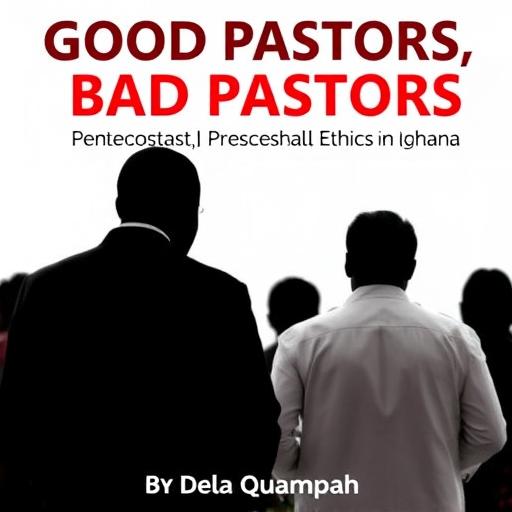
2014.Good Pastors, Bad Pastors: Pentecostal Ministerial Ethics in Ghana. (Eugene,
Oregon, Wipf & Stock Publishers.)x1+226pp.$25.00 paperback
Dela Quampah in this book examines the interface between Pentecostalism and Christian Ethics within the Ghanaian Pentecostal context. This is a major contribution to exiting literatures on African Pentecostalism and its idiosyn- crasies. The book is divided into eight chapters which include: background and context of the study; Ghanaian Traditional leadership milieu and the contextu- alization of Christianity; selected ethical theories and systems; Christian ethics; leadership structure in selected Ghanaian Pentecostal Churches; issues in Pen- tecostal Ministerial ethics in Ghana; an analysis of information on Pentecostal Ministers; and finally, a summary, conclusion, and recommendations. It is diffi- cult to comment on every single chapter of the book as there is not a weak link in this book.
The book explored the background and historical development of selected Ghanaian Pentecostal churches in order to identify the principles, significance, functionaries, factors and events that sharpen their ministerial ethics. Con- textual issues such as principles and sources that inform Christian ethics and ministerial ethics were examined by the author. The author adopted a mul- tidisciplinary approach research methodology in order to have informed and comprehensive conclusions. The author chronicles the trends in the devel- opment of Pentecostalism as both universal and Ghanaian phenomenon to uncover some of the historical factors and concepts that brought into place the value system of the movement.
The progress and expression of Pentecostalism has been remarkably impact- ful on Ghanaian Christianity and other facets of their national life. Conse- quently, the ethical example set by Pentecostal leaders may be posited as a significant contribution in determining the moral standards in the larger soci- ety. Pentecostal churches in Ghana and Sub-Sahara Africa have become a force to reckon with in the religious, social, economic and political discourses. This necessitates why the author explores the moral theories revealed in the insti- tutional stipulations of such ministers and the conduct of individual ministers.
The author demonstrates in situ knowledge about the Ghanaian Pente- costal landscape and the traditional leadership milieu. This is imperative as the author posits that traditional Ghanaian institutions, and their values, still have a vital significance on the contemporary Ghanaian religious landscape. The resonance of traditional idea’s with Christian concepts and practices that reflect on the African sense of community, awareness of spiritual reality and submission to leadership are points of reference in his discourse.
© koninklijke brill nv, leiden, 2016 | doi: 10.1163/15700747-03801012
1
242
book reviews
Quampah’s exploration of ethical theories is quintessential and its impor- tance to some of the issues confronting Ghanaian Pentecostal churches as well as African Pentecostal churches in Africa and diaspora cannot be over empha- sized. The author explores germane ethical theories, systems and Ghanaian ethical philosophy to assist in knowing their visible demonstration in minis- terial ethics and to ascertain their effect on the moral stance of Ghanaian Pen- tecostal churches and their leaders. A major assertion of the author is that min- isterial ethics could find a logical and objective terrain in Kantian ethics, but it can result in legalism which is not pragmatic to life and ministry. Though a bal- ancecouldbeprovidedforhisethicalpessimismbyutilitariansystem,however, it is liable to a maximal relativity that provides no basis for moral appraisal. The author also argues that virtue approach cannot stand alone either with- out appealing to act-oriented systems for validation. Also, the author was of the opinion on assessing the available documents on the sources of traditional Ghanaian ethics that evidence for a religious source is astounding was made.
Despite the exploration of philosophical and ethical issues, the author ade- quately explores the Biblical framework for ministerial ethics by interpreting and applying some the biblical and relevant scriptural passages in his dis- course. The uniqueness of this approach is the pragmatic disposition and local knowledge about Ghanaian Pentecostalism as he situates his discourse within contemporary issues of social norms, spiritual and institutional factors and per- sonal choices interact to shape church leader’s moral standards in ministry.
The author is not shy to delve into some of the challenges of Ghanaian Pentecostal Church leaders which resonate within the Pentecostal tradition at large. It is quite intriguing and a commendable scholarship as he is one of the leaders of Church of Pentecost, Ghana. The authors approach in this section is plausible as he situates his arguments within the wider Christian community and scholarship on the matter. Consequentially, the lack of appropriation of Christian ethics, it was observed, has resulted in laxity in relationships, power abuse, denial of women’s rights, and demonology are major banes of this flourishing Christian tradition not only in Ghana but in the Global South in general. This is reflected in the public opinion survey of the author within the Ghanaian Pentecostal scene as one of several examples of unethical behaviour within the Pentecostal tradition across the globe.
This is a pioneering work that saliently captures the contemporary ethical dilemmas and with in-depth description of the traditional Ghanaian cultural milieu which resonates with certain aspects of Pentecostal ideals. The ethical issues raised in this book are a true reflection of major criticisms of the Pente- costal movements across the globe. This book is highly commendable because of the insider’s perspective of the author as one of the leaders of the Church
PNEUMA 38 (2016) 215–243
2
book reviews
243
of Pentecost, Ghana. This book is a critical, nuanced, authoritative and a major contribution to existing works published by various African scholars on African Pentecostalism.
Babatunde Adedibu
Provost, The Redeemed Christian Bible College, Nigeria
PNEUMA 38 (2016) 215–243
3