
Click to join the conversation with over 500,000 Pentecostal believers and scholars
| PentecostalTheology.com
book reviews
413
William K. Kay
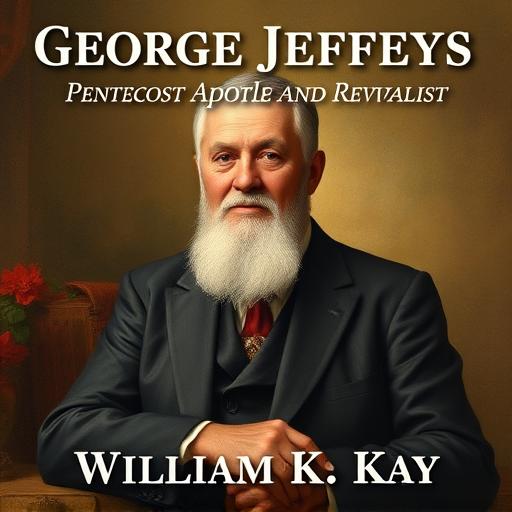
George Jeffreys: Pentecostal Apostle and Revivalist (Cleveland,tn:cptPress, 2017).
472 pp. $24.95 paperback.
William K. Kay’s career has seen him hold positions ranging from Pentecostal seminary to chairs of theology at universities in both England and Wales and for more than two decades he has published extensively in areas that relate to the doctorates he possesses in both theology and education. In short, Kay boasts an academic resume few Pentecostals in the British Isles can match. For this endeavour he has collaborated with cpt Press, an arm of the Centre for Pentecostal Theology residential library based in Cleveland, Tennessee, whose stated aim is to facilitate “the conception, birth and maturation of constructive Pentecostal Theology across the theological disciplines” (http:// pentecostaltheology.org/Home.html). All of this augurs well for the first full-length account of the life and ministry of George Jeffreys (1889–1962), a native of Wales and revivalist of some repute during the early decades of the 20th century. To date he has been the subject of memoirs and chronicles of modest proportions, but as the denomination he was instrumental in founding has recently marked a centenary of activity, it seems both timely and apposite that Kay would undertake to present the fullest account yet of the singular role played by this pioneer of British Pentecostalism. Indeed, those already attuned to such things may have found themselves salivating at the prospect and wondering if this might even prove to be themagnumopusof Kay’s notable career.
Yet it is not without reason that the life and ministry of Jeffreys have re- mained insufficiently documented. It is no small undertaking to provide an his- torical biography of this fascinating but complex man and to do so in a manner which would ideally engage both a general readership, as well as inform a more academic constituency, represents a challenge to which few have attempted to rise. Kay’s answer is to present us with something of a behemoth which stretches close to 450 pages of text and, on that basis alone, is not for the faint- hearted. Building on previous accounts, magazines of the movement, corre- spondence between key players and officials, minutes of meetings and confer- ence reports, he has constructed an edifice which takes the reader on a journey from the non-conformist world of 1890s Wales, to the social and spiritual chal- lenges of post-war Britain via evangelistic campaigning, clashes of religious charisma and bureaucracy, miraculous occurrence, strange doctrine, and fre- quently indecipherable motives and machinations.
It may be helpful to conceive of the volume as covering three phases, the first of which relates to Jeffreys’s background and early years. Here the picture
© koninklijke brill nv, leiden, 2017 | doi: 10.1163/15700747-03903013
1
414
book reviews
emerges of a promising young lad, who although having received only limited educational opportunities, appeared to those around him to be eager, earnest, and liable to make a success of whatever life might put in his path. Where gaps exist in knowledge, and they are considerable, Kay offers informed supposition which is generally plausible and convincing. The context of the religious life of Wales, the early years of the Pentecostal movement in Britain and Jeffreys’s fledgling evangelism in Ireland are set out in a clear, lucid fashion helpfully supported by selective available scholarship and primary sources. Kay wears his academic credentials lightly and seemingly effortlessly; the narrative moves forward into the 1920s and, as momentum grows for Jeffreys’ campaigning, readers will find themselves captivated by a heady optimism that seems to drift from the pages.
What could be conceived as the second phase of the book approximates to the “golden years” where, to borrow from David Bowie, the nights were warm and the days were young for Jeffreys and the burgeoning Elim movement. Trav- elling with his trusted Revival Party, he took his distinctive brand of Gospel presentation across mainland Britain to considerable effect. Elim’s magazine, the Evangel, reported souls saved and medical conditions healed in the capital as well as across “major provincial cities” (133). Stirring scenes are recounted such as the occasion in 1927 when several hundred Elim supporters travelled by train from Carlisle near the Scottish border to support a campaign in Glas- gow. Jeffreys, according to a contemporary participant, was “skilfully piloted” in his Chrysler car as he lead a procession through the streets while “the saints of God” marched solemnly toward the venue attracting attention from passers-by as they chanted “songs of Zion” (156–157). The Elim Foursquare Gospel Demon- stration held at the London’s Royal Albert Hall in the same year represented something of a pinnacle of attainment. Reports featured a much vaunted tele- gram exchange with the King, services which saw hundreds encounter the waters of baptism, afternoons devoted to the teaching and practice of healing, evenings where communion was observed on a vast scale. Having witnessed his methods first hand, Donald Gee was apt to conclude that Jeffreys’s plat- formpersonality “wasat timesmagnetic,”while he possessed“avoicelikemusic with sufficient Welsh intonation to add an inimitable charm” (130). For revival- ist and loyal following alike, these intoxicating days seem to have echoed the sentiment: Bliss it was in that down to be alive, but to be young was very heaven.
Yet a more appraising inspection will encounter questions relating to meth- odology as well as historiography. Kay relies extensively on the accounts pub- lished in the Evangel magazine as well as a 1928 account George Jeffreys: A Ministry of the Miraculous (London: Elim Publishing Office, 1928). Penned by insider and collaborator with the Revival Party, E.C.W. Boulton, this chroni-
PNEUMA 39 (2017) 365–424
2
book reviews
415
cle of the campaigns undertaken reported healings, miracles, and conversions, as well as reproducing photographs, all accompanied by the author’s charac- teristic rhetorical flourishes. Kay himself describes Boulton’s tone as “celebra- tory” (185) and his capacity to report events in such glowing terms and with such relentless positivity underscores just how sought after he might have been as a 21st century press officer or public relations guru. The Easter gath- ering at the Albert Hall was described as “epoch-making,” “beyond portrayal,” “unprecedented and unparalleled,” (Elim Evangel 16 May 1927, 144–147), while a campaign in Leeds, reputed to have achieved in excess of 2,000 converts, was lauded as “the greatest feat of modern evangelism” (159). A generous reading would suggest that Kay reports these accounts faithfully, while a more search- ingappraisalmightwonderwhyeuphoric hyperboleisreproducedwithsolittle qualification, much less meaningful interrogation.
Boulton and the Evangel are, in addition, replete with contemporary news- paper accounts which, on the basis of their selective reproduction, appear to have been uniformly and noticeably supportive. If less favourable comment did appearin print,Boultondid anadmirablejobin shielding theElim faithfulfrom it and Kay has evidently done little to explore whether or not this was the case or to disabuse readers of this impression. The more historically astute reader will notice the irony of how a report from the Morning Post of 19th April, 1927, for instance, is held up as containing “no debunking or scepticism … nor is the account second-hand” (166–167) while it is being cited third-hand via a source some ninety years old which exhibited a pronounced interest in propagating a particular line. A similar pattern is followed on, among others, pages 138–139, 158, 160, 170, 213. Chief among the cardinal lessons bequeathed to the world of learning by the Christian scholarpar excellence, Erasmus of Rotterdam, was the imperative of returning ad fontes, directly (or as directly as is possible) to the fountains, i.e. the original sources. An historical biography of this calibre could reasonably be expected to have retrieved and consulted at least some of the original newspaper reports before making significant claims on their behalf.
Kay does seem, in notable instances in this middle section, to have not only reiterated and reinforced what might be termed the Boulton rhetoric, but indeed gone on to offer his own variation. On more than one occasion Jeffreys’ attainments are compared to the venerable JohnWesley (e.g. p. 144, 243) who, it is claimed, even “in his heyday never saw in a single year the scenes witnessed by Jeffreys in those 12 months” (1927). Somewhat subjectively it is stated that “the energy and organisation, as well as the faith, demonstrated here by Jeffreys have not been seen in the British Isles ever before nor have they yet been equalled” (173). When it is considered that Wesley traversed in the region of 250,000 miles on horseback, an averageof twenty miles a dayoverfour decades,
PNEUMA 39 (2017) 365–424
3
416
book reviews
that he preached approximately 4,000 sermons, penned some 400 books, and established Methodism as a bulwark of Christianity not only throughout the British Isles but across the English speaking world, the claim that the level of energy, organisation and faith demonstrated were unique and unsurpassed— asserted, furthermore, without reference to a singleWesleyan source—remains unconvincing. It may indeed have been “remarkable” that Jeffreys managed to complete his fourth and final book,PentecostalRays, during the first half of 1933 while attending to “many other duties and engagements” (241).Yet when placed more objectively alongside the achievements—literary and otherwise—of an evangelicalcolossussuchasWesley,theobservantreaderisapttoconcludethat Kay, seemingly in the light of the hyperbole of an earlier generation, has chosen to offer an inspirational slant more attuned to the pulpit than the seminar room.
The book’s final section moves into complex territory which sees Jeffreys begin to “chafe at the restriction of the Elim organisational machine” in a man- ner which precipitated a “crumbling of trust” and a long slow disintegration of relations that had been “cemented over 15 years of brilliant collaboration” (187, 283). These developments which occurred over several years from the mid-1930s, and the manner in which they are recounted, call to mind Matthew Arnold’s depiction of a “melancholy, long, withdrawing roar” in his metaphoric poem Dover Beach. The revivalist began to espouse British Israelism which has been variously described as a “racialist distortion of the faith” and a “mixture of legend and pseudo-science” (Horton Davies, Christian Deviations: Essays in Defence of the Christian Faith. London: scm Press, 1957, p. 20; and Malcolm R. Hathaway, “The Elim Pentecostal Church: Origins, Development and Distinc- tives,” in Keith Warrington, ed., Pentecostal Perspectives. Carlisle: Paternoster Press, 1998, p. 22). While surprisingly little is quoted directly from Jeffreys, it remains clear that he had become infatuated by what was, for certain sectors of the wider Church at the time, an enthralling means of interpreting the sig- nificance of Britain and its Empire in the light of Old Testament scripture and prophecy. Elim’s early ministerial conferences debated the issue at the behest of their talismanic figurehead, but only a minority ever came to share his out- look.
Other agendas, relating principally to ecclesiology, were introduced and Jef- freys, having initially worked toward the establishment of a centrist, centripetal denominational system, conducted a volte-face and became a passionate agi- tator for congregational autonomy. It is difficult not to arrive at the conclusion that this newfound zeal was, at least to some extent, motivated by a desire for liberty to propagate idiosyncratic views and win congregations to his way of thinking. Rapprochements were attempted, but dissension prevailed and, just
PNEUMA 39 (2017) 365–424
4
book reviews
417
as Britain and the world were spiralling into the calamity of the Second World War, the man around whom a revivalist movement had found its identity, with- drew to form an alternative body.
These torturous developments are recounted in what, for many readers, will prove excessive detail. Wrangling at conference, back-room machinations, and the unedifying tug-of-war between the parent body and Jeffreys’ rival offshoot over church buildings and indeed congregations, all feature ingloriously in this protracted sundering. What was appropriate subject material for a doctoral study undertaken in relation to Elim’s schism—a study drawn upon extensively in this section—does not, however, readily translate as readable and engaging material for a more general historical biography (Neil Hudson, “A Schism and Its Aftermath: An Historical Analysis of Denominational Discerption in the Elim Pentecostal Church, 1939–1940” PhD dissertation, University of London, 1999). It would appear that cpt Press has adopted something of a laissez faire stance in its editorial policy and it is difficult not to conclude that a more streamlined approach, particularly in this section, would have borne dividends.
In the closing stages Jeffreys is shown to have become a “reactionary fig- ure” who did not share other Pentecostals’ sanguine outlook for evangelism and widening influence in post-war Europe. Instead he “engaged in a running battle” with the World Pentecostal Conference denouncing a perceived “grave injustice” then being perpetrated upon “thousands of Pentecostal assemblies and pastors” who were being made “unsuspecting parties to this world-wide organisation without their proper consent” (415. 409). It is aptly noted that he was disposed to “obsessional traits as well as unbending adherence to selected principles and concepts.” While these traits had been fruitfully devoted to a Pentecostal proclamation of the Gospel in the first half of his ministry, the second saw them obstinately, relentlessly and narrowly applied to matters of church government. Having made the ultimate stand in his original Elim con- text, he was evidently determined not to be seen to waver, much less recant, but instead pursued his convictions to the nth degree in the spirit of a great Reformer: Here I stand. I can do no other. There was to be no reconciliation between Jeffreys and the Elim Pentecostal Churches “official, public or sym- bolic,” it would seem. Yet displaying a sanguinity of his own, Kay offers the wistful conjecture that had he “mellowed and reached out to those whose opin- ions he could not quite accept, he would have become an elder statesman to Pentecostalism in Europe and perhaps the English-speaking world” (417–418, 423).
Overall, it is the case that Kay provides a biographical rendering which has drawn upon and compiled previous treatments of Jeffreys and the Elim story, with the additional incorporation of some general historical background and
PNEUMA 39 (2017) 365–424
5
418
book reviews
context. While a chronological pattern is presented, frequently in a workman- like fashion—more by way of secondary comment and engagement would have been welcome—there are instances of valuable insight and memorable assessment to be savoured. This timely volume gallantly attempts to cater for and satisfy various readerships and, while not succeeding on every level, contains much to reward pastors, students, would-be evangelists, and those with an inside-interest in the workings of Elim. It may not be the definitive publication for which Kay will be remembered, but it will remain a staple source for some time to come.
Timothy Bernard Walsh
Regents Theological College, West Malvern, Worcestershire, United Kingdom
PNEUMA 39 (2017) 365–424
6

Dr. Mark
While this review purports academic scrutiny, its reliance on internal Pentecostal archives and its publication within Pneuma Review itself fails to adequately challenge the inherent biases of hagiographic accounts often found in denominational histories. The initial framing of George Jeffreys as a “pioneer”
Troy Day
THis is a GREAT picture of him Jeffry Woolston while yours is getting more and more distorted with your lack of identity