
Click to join the conversation with over 500,000 Pentecostal believers and scholars
| PentecostalTheology.com
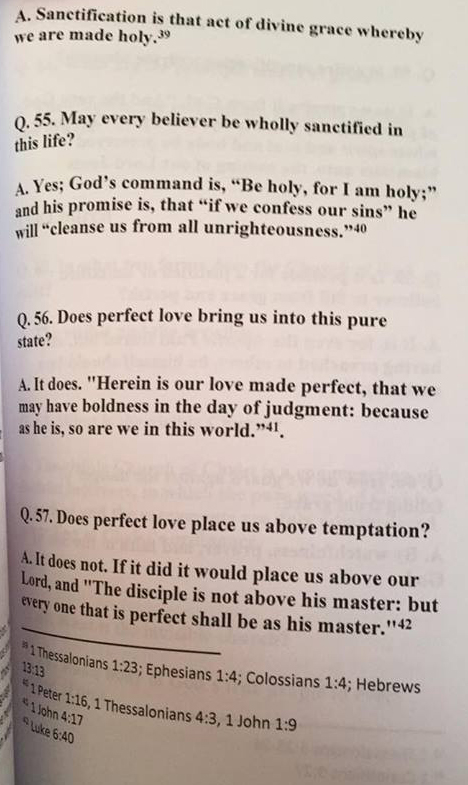
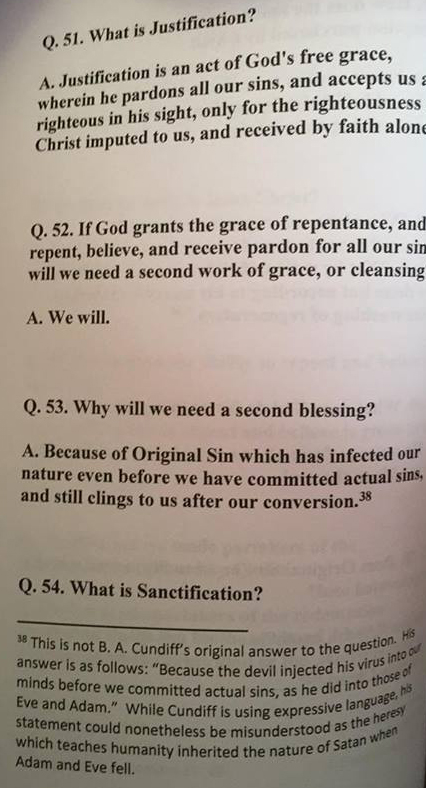
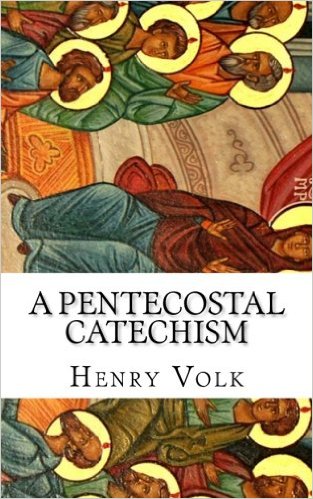 Q. 52. If God grants the grace of repentance, and we repent, believe, and receive pardon for all our sins, will we need a second work of grace, or cleansing?
A. We will.
Q. 53. Why will we need a second blessing?
A. Because of Original Sin which has infected our nature even before we have committed actual sins, and still clings to us after our conversion.
Q. 54. What is Sanctification?
A. Sanctification is that act of divine grace whereby we are made holy.
Q. 55. May every believer be wholly sanctified in this life?
A. Yes; God’s command is, “Be holy, for I am holy;” and his promise is, that “if we confess our sins” he will “cleanse us from all unrighteousness.”
PURCHASE FROM: https://www.amazon.com/dp/1539696626/


Charlie Robin
Charles Page Ricky Grimsley Q. 52. If God grants the grace of repentance, and we repent, believe, and receive pardon for all our sins, will we need a second work of grace, or cleansing?
Henry Volk
It’s like the old hymn says, “There’s a highway to Heaven, none shall walk up there, but the pure in heart.”
Charles Page
The regenerate state from new birth is “pure in heart” They are ready for eternal life, heaven.
Charles Page
only God can raise a dead man (dead from original sin) to a state of life. The dead do not cooperate in this gift of new life.
Henry Volk
But that’s not sanctification.
Charles Page
Exactly
Dolores Robinson Volk
I think Sanctification is the ability to live a Holy life that only possible through the power of God.
John Ramos
Thomas Aquinas in Operating, Co-Operating, and Prevenient Grace defines justification as being “made righteous” by grace hence he writes of justification as sanctifying grace
Charlie Robin
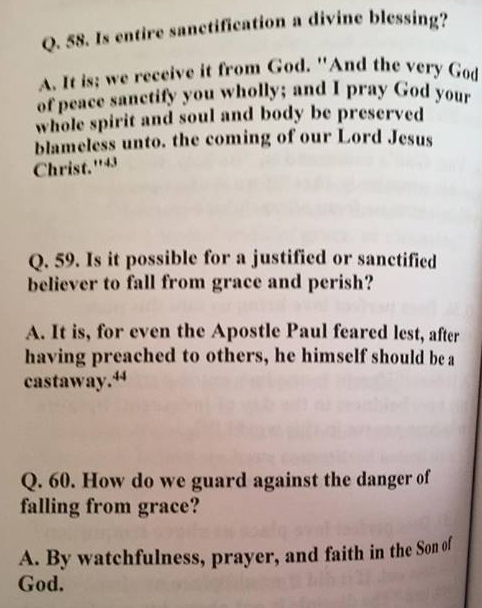
Q. 53. Why will we need a second blessing?
A. Because of Original Sin which has infected our nature even before we have.
Charlie Robin
Henry Volk I hear 10% of all proceeds go to the Charles Page 70 AD FUND Ricky Grimsley Timothy Carter Alan N Carla Smith
Henry Volk
???
John Ramos
Hey Timothy Carter I think Charles Page is calling for his 10%
Timothy Carter
Brother Charles Page preaching on the importance of tithes in, BC 1000.
John Ramos
I’d say definitely way before Melchizedek right?
Timothy Carter
Yes, I believe this was before Melchizedek, see how young brother Charles Page is in the photo.
Ricky Grimsley
Lol. Why would the 70 AD fund need money…..all their mission was fulfilled by 70 AD?
Charlie Robin
70 people have to mail a check for $70 each in 70 hours in order to find out Henry Volk Charles Page #ThisIsAJoke
Charles Page
Charlie Robin start by contributing some rubles to make the total an even 5000
Charlie Robin
Alternatively 70 people could buy 70 copies of the book each in the next 70 hours to virtually same effect Henry Volk
Charles Page
and no stingy prayer cards w/o any money!!!
Charlie Robin
Going LIVE @ 5 its 5 o’clock somwhere
Henry Volk
That’s true! I promise a special seed faith anointing for those who buy now! Lol. Actually, I’ve updated the manuscript, so the book won’t be available for at least 24 hours.
Charles Page
I am trying to raise $5000 to buy the T.L. Lowery world outreach center and start a Pentecostal Preterist Präteritum
First I am seeking a 8000 sq ft residence for my wife and myself.
Henry Volk
Charles Page what’s my ROI on this?
Charles Page
Henry Volk that’s true there will be some residual income for you. It will be paid in rubles!
Henry Volk
Hmmmmm, ???
Charles Page
Henry Volk You will have peace and happiness and 100 fold joy!
Joseph D. Absher
Is grace here defined impetus and ability to see our sin feel remorse and come to God for pardon???
Charles Page
That would perhaps be a result of the ransom theory of atonement. A purchased atonement
Henry Volk
More or less
Joseph D. Absher
I never heard of no random theory of atonement. Wasn’t the Lamb of God slain from the foundations of the earth??? Theologians wheww!!!
Charles Page
The substitutionary theory does not require any action on our part. It is substitutionary
Henry Volk
I don’t really see what the disagreement is.
Ricky Grimsley
Its more than that
Joseph D. Absher
Yes of course, it is the manifold grace of God after all.
John Ramos
Catholics, Orthodox and some Protestants agree that grace is conferred through the sacraments, “the means of grace” Means of Grace are God’s instruments by which all spiritual blessing are bestowed upon sinners
Charles Page
no, the means of grace are the works the unregenerate do to receive the grace of God. In sacraments the church is the means and in Protestants it is the unconverted who receive by decision the grace of God.
In the Bible God’s works are the means to eternal salvation.
Timothy Carter
What? Please explain.
Charles Page
What is it you don’t understand?
Then I can explain
Timothy Carter
Are you saying:
” the means of Grace” is what an unconverted person does to become converted? That somehow the work, action that the unconverted does creates a pathway for Grace to flow?
Charles Page
means of (Protestant) grace = going down to an altar, shaking the preacher’s hand, crying and weeping at an old fashion altar, repenting of your sins, saying a sinner’s prayer, accepting Jesus into your heart – it is earned regeneration through an unregenerate cooperating with God in receiving the gift of regeneration. There is no grace apart from our efforts. Wesleyanism holds that an unregenerate receives a saving grace (prevenient grace) that prevents the hindrances of original sin for the unregenerate to receive Christ’s atonement.
Sacramental regeneration is an unregenerate receiving the new birth (regeneration) through the agency of the church via a priest.
I reject both decisional regeneration, including Wesleyan regeneration and baptismal (sacramental) regeneration.
Joseph D. Absher
A couple of things here if I may, maybe my difficulty is terminology. Like, “theory of atonment” there is a theory of relativity but a law of gravity. It may be I’ve taken offense when there is none. For me, theory and atonement don’t belong in the same sentence! Also considering the definition of grace or the work of grace in the hearts of men is no small matter thus my effort to clearly define it in this particular line of thinking. The grace of God is too broad a subject for these narrow posts. Further I use grace as not just “unmerited favor” but the divine influence on the heart and character. The Eskimos have some 30? Words for snow. So I try not to “drill down’ so deep. It is sufficient for me that a man’s spirit is born again and draws life and sustenance from , prayer, fellowship, the word of God, and worship (to include tithes) from my simplistic view these are ” means of grace”
Charles Page
+so you hold to penal substitutionary atonement? anything differing is theoretical like government, example, satisfaction etc.
John Ramos
The problem here is that Charles Page does not buy into original sin, yes Adam sinned but was it transferred to all humanity in perpetuity?
John Ramos
Technically speaking, substitutionary atonement was a Catholic joke which opened the door for Thomas Aquinas’ self-Satisfaction doctrine rooted in the idea of self-penance Henry Volk
Henry Volk
Wait what?
John Ramos
Christ punished instead of us is a subset or particular type for a true substitutionary atonement. Barth in his Doctrine of Reconciliation primarily uses PSA (without some of its Anselmian baggage) to describe the universal implications of Jesus Death and Resurrection. Specifically he calls Jesus the “Judge Judged in our place.” Henry Volk Do you want me to type slower so you can follow 🙂
Timothy Carter
Type slowly, for me please. ( laughing, slowly)
Timothy Carter
What do you mean that Substitutionary Atonement was a Catholic joke. Substitutionary Atonement is the name attributed to the atonement we have through Jesus. Jesus died as a substitute for us.
1 Pet 2:24
He himself bore our sins in his body on the tree, that we might die to sin and live to righteousness,
1 Pet 3:18
Christ also died for sins once for all, the righteous for the unrighteous, that he might bring us to God.
Am I missing something?
Henry Volk
It has its roots with Anselm who deviates slightly from the dominate Ransom theory of the time. However, it’s not like people were specifically talking about atonement theories at that time or trying to formulate new ones.
John Ramos
Just one thing – do you believe Christ suffered for us or Christ suffered in our place instead of us? Let’s go back to Millard Erickson and the Biblical foundation for Governmental theory of atonement http://www.theopedia.com/governmental-theory-of-atonement
Timothy Carter
As Dr. Steven Lamb would say, “Yes.” I have always thought of it as being, Christ suffered For us, as to say, He did us a favor. Also, I have felt Christ suffered instead of us. We deserve this suffering. He does not.
Timothy Carter
I do not agree with the Governmental Theory of Atonement, which says, “This [governmental atonement] view holds that Christ by His death actually paid the penalty for no man’s sin.” Because, in Matt we hear
Jesus say,
“The Son of Man did not come to be served, but to serve, and to give His life as a ransom for many” Matt 20: 28).
Hebrews 9:28 “So Christ was offered once to bear the sins of many. . .”
Hebrews 10:10, 11,12, 14
By that will we have been sanctified through the offering of the body of Jesus Christ once for all. But He, having offered one sacrifice for sins for all time, sat down at the right hand of God. For by one offering He has perfected forever those who are being sanctified.
Timothy Carter
This leads us to the Ransom Theory of Atonement, which I believe would be a great discussion in and of itself. I will start one.
Charles Page
Joseph, this is a discussion about theories of atonement!
John Ramos
He government atonement covers multiple since virtually all sins without being the doer but the judge. Barth held the judged judge theology very highly. Christ dying in our behalf denotes Christ taking our sins, removing it from us and making us righteous (not sinners). Christ dying for us is a bit more limited in the means that in order for Christ to forgive all our sins He would have known all of our since before hand. This borders including that Christ also fore-knew and pre-decided the elect so Ricky Grimsley will immediately jump in to tell us this atonement is limited and perhaps just for a few but not for all sinners and thus Calvinistic. Government atonement escapes all Cavlinistic traps and allows Christ to die for all sin in general as Barth called it “the judged Judge” thus accepting all sinners and affirming their entire sanctification in the Spirit…
Timothy Carter
I have not seen Government Atonement like this before. My veiw has been as I stated about. Now, I think maybe, I should read more about it.
Charles Page
Universalism
Ricky Grimsley
Since when am i a Calvinist. Lol b
Charles Page
I told on you
Peter Ciple
The Holy Spirit of God! https://www.facebook.com/334435539991308/photos/a.334437783324417.58385.334435539991308/659194687515390/?type=3&theater
Ricky Grimsley
I lean towards open-theism not calvinism.
Charles Page
Open theism is moderated Calvinism -little difference
Varnel Watson
Open theism and hyper calivinism are the extremes of one and the same ol thing Charles Page is right for once since 70 AD