Click to join the conversation with over 500,000 Pentecostal believers and scholars
| PentecostalTheology.com
Used with permission, SELECTED QUOTES by Paul L. King, D.Min., Th.D.
[INTRO point by Paul L. King, D.Min., Th.D.] In 1914 E.W. Kenyon, whose later teachings would make him known as the founder of the modern faith movement, wrote an article for Carrie Judd-Montgomery’s Triumphs of Faith magazine on the believer’s authority and binding and loosing.69 Before he began to err grievously, he had contacts with the Keswick movement, so it is likely he was drawing upon the principles Roberts and Penn-Lewis had mentioned two years prior, as well as Meyer’s earlier teaching. In her 1921 book The Secrets of Victory Carrie Judd-Montgomery devoted an entire chapter to binding and loosing, admitting it was a recent perception that had transformed her ministry. ~ 69 E.W. Kenyon, “Legal Authority,” Triumphs of Faith (December 1914): 283-284.
[POINT 1 by Paul L. King, D.Min., Th.D.] Christian and Missionary Alliance missionary John A. MacMillan really wrote the seminal book on the believer’s authority with his series of articles based on Ephesian 1 in 1932.73 In effect, he developed the theology at that time for the recovered understanding of binding and loosing. The seventh edition of the unabridged version of Penn-Lewis and Evan Roberts’ book War on the Saints (published in 1933) makes reference to MacMillan’s articles in the Alliance Weekly.74 No doubt MacMillan was influenced by his mentor Robert Jaffray and the teaching of Penn-Lewis. His material is referred to by a wide variety of contemporary Christian leaders, including dispensationalists like Merrill Unger, evangelical publishers like Moody Press, evangelical scholars like Professor Timothy M. Warner and charismatic faith leaders like Kenneth Hagin.75 Chinese spiritual leader Watchman Nee, who was influenced by Penn-Lewis, Simpson and Andrew Murray, also taught authoritative “commanding” prayer and the power of binding and loosing in 1934.76 So we see that by the early twentieth century the teaching on binding and loosing as the believer’s authority had proliferated among evangelical leaders.
[POINT 2 by Paul L. King, D.Min., Th.D.] Parallel with these developments, in 1916 E. W. Kenyon, considered the father of the modern faith movement, also believed in a concept of territorial spirits. Theologian and historian Douglas Jacobsen notes, “Kenyon believed Satan divided the world into a host of separate ‘kingdoms and states, and communities’ and gave various demons control over those territorial domains. Virtually every community was assigned a territorial demon to oppress and control all forms of life in that region of the planet.”12
[POINT 3 by Paul L. King, D.Min., Th.D.] Further Development of the Concept by John MacMillan: C&MA missionary John MacMillan, perhaps more than any other Christian leader of his day, began to develop more of a concept of territorial influences. Some personality trait weaknesses that are usually considered characteristic of a certain nationality or ethnic group, MacMillan suggested, are “quite as likely to be a working of that undercurrent of Satanic force.”13 He posited the atheism of Russia and the unexplainable submissiveness of its people as due to an occult power, what he calls a “hellish counterfeit.”14 For most heathen religions, MacMillan explained, “Every god is confined to definite territorial limits, outside of which his influence does not extend.”15 MacMillan viewed Daniel 10 as an example of prayer activating God’s interference with “mighty intelligences” manipulating people, governments, and circumstances.
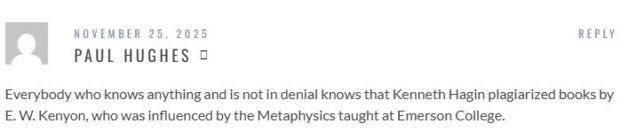
If you actually READ McConnell’s book, A Different Gospel, he puts long passages of Kenyon and Hagin booklets side-by-side and proves that they are almost identical, just slightly reworded in places. When one talks about Christian Metaphysics, one is basically talking about Neoplatonism, which theorizes about ascending toward personal divinization through methodologies such as Contemplative Prayer, which I happen to have written a book about. Neoplatonism as religion goes back to Pagan philosophers Ammonius Saccus and Plotinus, and Christian Neoplatonists Origen and Clement of Alexandria.
Dan Cross: Paul Hughes I went to church with McConnell and took a postgraduate Greek reading course at ORU with him under Dr. Mansfield. When he published his books, I debated with him on the steps of the ORU library. While I have my own criticism of Bro Hagin’s theology  I said to him that his criticisms attempt to apply post graduate, doctoral academic publication standards to a country preacher who had it best a Bible college education. Bro Hagin did, however, have what I would suppose would be a photographic memory and could recite almost verbatim anything he read. And the standard did he applied to the writing of his books was the same that he applied to his sermons. In fact, brother Hagan had ghost riders who wrote his books for him compiled from his sermons and teachings. When won understands that process a major point of Dr. McConnell‘s book seems rather ludicrous. What Baptist, Evangelical Presbyterian, or other evangelical preacher has not ripped off Charles Spurgeon sermons? McConnell did not write a book about them.
In Dr. Mansfield’s doctoral Greek reading class on Mark. He used his own book “the Spirit and gospel in Mark “. In that class, with McConnell present, I confronted Dr. Mansfield about an apparent bias in which he seemed to import into his exegesis and hermeneutic the cultural context of Tulsa charismatics into the setting in which Mark was written the train his own biases. At the time there was very much a rival between ORU seminary and Rhema Bible School that seemed to bleed through professors discourse. McConnell was there, he heard my criticisms, Mansfield failed to answer them, and he saw that I received an a for the paper that I presented in rebuttal. I want to be very careful here because it is very easy for we ourselves to slip into the same pride that we identify in others. So I am walking on a very dangerous precipice here. But it has been my experience that there was pride on both sides of that rivalry. And I think that McConnell‘s book “academized” a prideful reaction. The truth is that Rhema has its faith formulas and ORU has it systematic theology—and both thought they were superior to the other—a very sad occurrence in the body of Christ, especially for those preparing for his ministry
=> A quick Internet search reveals that Dan McConnell seems to have dropped off the face of the Earth. His social media accounts appear to be inactive. All Internet listing seem to be associated with the book and or with crossroads international Church. Looking under crossroads international Church, he is nowhere among the pastors. A search for him by name alone, yields nothing.
[OBEJECTIVE] Here is a concise one-sentence, numbered outline of the main points:
SOURCE URL => https://www.pentecostaltheology.com/cultic-origins-of-word-faith-theology-within-the-charismatic-movement/
- The Word-Faith doctrine of “positive confession” is built on the presupposition that all Christians are divinely guaranteed physical health and material wealth.
- Kenneth Hagin teaches that spoken words activate faith and actually create reality, making verbal confession as powerful as belief itself.
- This theology depends on a spiritual–material dualism that denies physical reality, treats sickness as merely a “symptom,” and elevates spirit over the body.
- These ideas closely mirror 19th-century mind-healing cults, especially New Thought, which taught that thoughts and words directly shape physical health and success.
- Phineas Quimby originated the concepts of correct thinking and belief as the source of healing, which later evolved into verbal affirmations.
- Christian Science, through Mary Baker Eddy, systematized the denial of illness, the unreliability of the senses, and healing through mental affirmation.
- The Unity School of Christianity further developed formal techniques of denial and affirmation specifically for both healing and financial prosperity.
- The article argues that these systems transfer God’s creative authority to human speech, effectively granting people the power to “create” reality.
- Modern prosperity and Word-Faith teachers absorbed these doctrines primarily through E. W. Kenyon and later popularized them through figures like Hagin, Cho, Peale, and Schuller.
- Evangelical and Pentecostal scholars widely reject these teachings as doctrinally unsound, historically rooted in cultic metaphysics, and harmful to biblical faith.
Paul L. King, D.Min., Th.D.: [Dr. Troy Day of HDS] has asked me to interact with this discussion.As my schedulle is very heavy, I can respond only briefly at the moment, and as Troy has already stated, this has been discussed at length in the past. So I will give just an overview of my background in this post, then a brief bullet point response to the issues.
1. My background for this: I am an ordained Christian and Missionary Alliance (C&MA pastor, theologian, and historian, who has spoken in tongues for more than 50 years. I served on the faculty of Oral Roberts University for 16 years, as well as other colleges and seminaries
2. My first doctoral dissertation (D.Min., ORU)—600 pages—was “A Case Study of the Authority of the Believer in the Life and Ministry of John A. MacMillan.” MacMillan was a missionary and spiritual warfare pioneer with the C&MA in the 1920s, and professor of Nyack College and Editor of the Alliance Weekly 1930s-early 1950s (followed by A.W. Tozer). My biography of MacMillan distilled from the dissertation was published as “A Believer with Authority: The Life and Message of John A. MacMillan.” I also showed that MacMillan was the original seminal author on his book The Authority of the Believer, which began as a series of articles in the Alliance Weekly in the 1930s, then published as a tract or booklet, then more of his material was compiled together as a full book. I most recently published an updated and expanded version of his original classic.
3. My second doctoral dissertation (Th.D., University of South Africa) was “A Practical-Theological Investigation of Classic and Contemporary Faith Theologies”, published as “Only Believe: Examining the Origin and Development of Classic and Contemporary ‘Word of Faith’ Theologies.” My thesis was basically sorting out and discerning what is sound and what is unsound in modern word of faith theology and practice. While there is much that is unsound, not all of it is, and much of it is based, not only on Kenyon, but what I call the classic word of faith leaders—George Mueller, Hudson Taylor, F.B. Meyer, Oswald Chambers, Charles Spurgeon, Andrew Murray, A.B. Simpson, John MacMillan, F.F. Bosworth, as well as Pentecostal leaders like Smith Wigglesworth, Carrie Judd Montgomery, John G. Lake, and many others.
4. Both of these dissertations involved extensive research into Kenneth Hagin, E.W. Kenyon, and many other contemporary word of faith teachers.
5. The first academic critiques of the modern word of faith movement came from Dr. Charles Farah, Professor of Theology at Oral Roberts University, Ph.D. from the University of Edinburgh, Scotland. He first presented a critique paper at the Society for Pentecostal Studies in the late 1970s, then published the book “From the Pinnacle of the Temple: Faith or Presumption.”
6. After that came a spate of critical papers and books, most notable being Dan McConnell’s “Another Gospel” and Hank Hanegraaff’s “Christianity in Crisis.” My research showed that both books, though containing elements of truth, are highly inaccurate and grossly exaggerated, which I demonstrate in “Only Believe.”
7. The other important background information is that Dr. Farah had been involved with the Navigators before becoming a professor at ORU, and his life was invested in discipling and mentoring men. I was one of those men, as well as Dan McConnell and Dale Simmons, who was going to co-author the book with Dan McConnell, but backed out. Even though Dr. Farah (or, Chuck, as we knew him) was critical of word of faith, he believed McConnell had gone too far, and Dr. Farah had encouraged Dale and myself to do doctoral work to set the record straight. I dedicated my book “Only Believe” to Dr. Farah, but he had passed away before seeing the finished work.
8. In my next post, I will address the issues more specifically.
William DeArteaga: That was 30 years ago. The evidence is cited in the footnotes.
Paul King: Now that you have the background, I will address the issues more specifically;
1. Yes, Hagin did use Kenyon extensively. I don’t have data on whether direct quotation or thought for thought. Dale Simmon’s paper, referenced in Point 2 below, wrote that Hagin’s plagiarism of Kenyon was minor compared to his plagiarism of MacMilla.
2. But on the authority of the believer, Hagin used MacMillan extensively. Dale Simmons wrote a 16-page graduate paper at Oral Roberts University entitled “Mimicking MacMillan” in which he showed, side-by-side, 24 statements (some of them lengthy) from Hagin’s “The Authority of the Believer” and MacMillan’s “The Authority of the Believer”, demonstrating that Hagin quoted MacMillan in many cases virtually word-for-word, and in some cases a close paraphrase. Additionally, Simmons showed a thought-for-thought close comparison. His conclusion was that Hagin had plagiarized MacMillan extensively.
3. On the surface, this plagiarism appears evident and could have been a legal issue. Hagin was confronted by the publisher of Christian Publications, the C&MA publishing house where MacMillan’s book was published. As a result, Hagin rewrote his book, titling it as “The Believer’s Authority” and acknowledging MacMillan as a source.
4. DeArteaga, in Quenching the Spirit, stated that Hagin had a photographic memory. While that is in the realm of possibility, and I would not rule it out, such I don’t recall if DeArteaga had verifiable documented evidence, as that kind of evidence might be difficult to obtain. In Hagin’s response to Christian Publications, he alluded to revelation from the Holy Spirit being given similarly to different people, but he mentions nothing about having a photographic memory. DeArteaga also mentions Hagin as doing “informal borrowing” as other preachers do. This is more verifiable.
5. In my research, I talked with a staff member of the ORU library who had been on staff at Hagin’s Rhema Bible Training Center, who gave the most likely scenario: In the 1960s, Gordon Lindsay, founder of Christ for the Nations Bible Institute, transcribed Hagin’s sermons into books. And as so many pastors have done through the years, they use other people’s material and preach other people’s sermons without mentioning whom they are quoting, so probably the case here that Hagin’s teaching on the authority of the believer probably used MacMillan’s material (as well as Kenyon’s material) and the transcribed sermons never gave a citation in the books.
6. I verified this myself, as I listened to a cassette tape of Hagin on the authority of the believer in 1967 (the same year his original book came out). Though Hagin never mentioned MacMillan in his sermon (although it is possible that he might have mentioned MacMillan before the tape recording began or in an earlier sermon in a series or conference, and/or the audience may have seen him reading from MacMillan), as I listened with MacMillan’s book in my hand, it was clear that he was quoting directly word-for-word from MacMillan, with the exception that when MacMillan would mention a Greek term, Hagin would skip over it and not mention the Greek. Again, apparent plagiarism, but not any different than what I know that many preachers do.
7. In my dissertation on MacMillan, I show in a side-by-side comparison that Wesleyan holiness preacher, Bible school president Paul Billheimer in a 1952 article for Herald of His Coming quoted MacMillan eight times verbatim without mentioning MacMillan as the source. I also show side-by-side two instances in which F.F. Bosworth in Christ the Healer cites Andrew Murray verbatim but without mentioning the source. Further, MacMillan borrows phrases from Jessie Penn-Lewis, George Pember, and perhaps even Watchman Nee (Latent Power of the Soul) without acknowledging the source. So this appears to have been common practice in earlier days, but clearly not acceptable today.
To respond to Paul Hugh’s post and link to McConnell’s updated book “A Different Gospel,” I have both the original and the updated, and frankly, not much is updated. Other than his response to DeArteaga, Dan does not interact with other scholarship since his original book that, while most of them still being somewhat critical of Hagin and Kenyon and word of faith, are not nearly as critical and have much more in-depth and balanced approaches.
In 2004 I talked with Dale Simmons, who was going to co-author the book A Different Gospel with McConnell, but Dale found out that McConnell’s information was inaccurate and backed out. McConnell went ahead in spite of Simmons warnings. Dale Simmons went on to research Kenyon in-depth in his PhD. Dissertation through Drew University, entitled “E.W. Kenyon and the Postbellum Pursuit of Peace, Power, and Plenty.” Dr. Simmons concluded:
“As for Kenyon himself, it would appear that he is best placed within the Keswickean/ Higher Christian Life tradition. . . . This is not to say that there are not aspects of Kenyon’s teaching—specifically those centering on one’s confession—that he stresses to a point that is only comparable to that of New Thought. . . . It would be going too far to conclude that New Thought was the major contributing factor in the initial development of Kenyon’s thought.”
After talking with Dr. Simmons at the Society for Pentecostal Studies some time later I saw Dan McConnell and asked him about Kenyon’s Keswick/Higher Life connections, McConnell said he did not know anything about it. He was not forthright with me, and he ignored Dan Simmons. Our own mutual mentor Dr. Farah had said he had gone too far. McConnell touts his book as being updated in 2011, but he does not reference or dialogue with any of the scholarly works between his first and second edition except DeArteaga.
Here are a list of the scholarly sources,
• Dale H. Simmons, E.W. Kenyon and the Postbellum Pursuit of Peace, Power, and Plenty (Lanham, MD and London: The Scarecrow Press, 1997);
• Joe McIntyre, E.W. Kenyon and His Message of Faith: The True Story (Lake Mary, FL: Creation House, 1997),
• Robert M. Bowman, The Word-Faith Controversy (Grand Rapids, MI: Baker Book House, 2001),
• Geir Lie, “E.W. Kenyon: Cult Founder or Evangelical Minister? An Historical Analysis of Kenyon’s Theology with Particular Emphasis on Roots and Influences.” Masters thesis, Norwegian Lutheran School of Theology, 1994;
• Derek E. Vreeland, “Reconstructing Word of Faith Theology: A Defense, Analysis and Refinement of the Theology of the Word of Faith Movement.” Paper presented at the 30th Annual Meeting of the Society for Pentecostal Studies, Oral Roberts University, Tulsa, Oklahoma, March 2001.
• Paul L. King, “Theological Roots of the Word of Faith Movement: New Thought Metaphysics or Classic Faith Movements,” paper presented to the Society for Pentecostal Studies Annual Conference, March 11-13, 2004, Milwaukee, Wisconsin
• Paul L. King, “A Practical-Theological Investigation of Nineteenth and Twentieth Century “Faith Theologies,” Doctor of Theology thesis, University of South Africa, 2002.
• Paul L. King, Only Believe: Examining the Origin and Development of Classic and Contemporary Faith Theologies (Tulsa, OK: Word & Spirit Press, 2008).
• Eddie Hyatt, “The Nineteenth Century Roots of the Modern Faith Movement,” unpublished paper. Tulsa, OK: Oral Roberts University, April 25, 1991.
Here is one very important study from Robert Bowman, who had worked with and for Hank Hanegraaff. Bowman took a quote to his boss about the Kenosis passage in Philippians 2, and asked Hanegraaff what he thought of it. Hanegraaff declared the quote heretical, but Bowman revealed that the quote was from Hanegraaff’s former boss Dr. Walter Martin. Hanegraaff showed he did not know what he was talking about, He didn’t know the difference between heretical and non-heretical views of Kenosis.
So Bowman did his own research on Kenyon. Taking a more scientific approach than McConnell and Hanegraaff, Bowman compared 23 standard New Thought concepts with Christian Science and Kenyon. From this statistical analysis, he concluded that while there is much in common between Christian Science and New Thought, there is “little resemblance” between Kenyon and New Thought. Further, he concluded that Kenyon is “far closer to orthodoxy than is Christian Science.” Kenyon may share some similarity with metaphysical thought, but his views are “fundamentally different.”6 He demonstrates that McConnell’s methodology is faulty, and thus his conclusions regarding Kenyon’s connections with metaphysical New Thought are deeply flawed. While there may have been some metaphysical influence, Kenyon’s views are more unlike such concepts than like.
TakeAways from Dr. Paul King:
1 Dale Simmons was going to co-author the book A Different Gospel with McConn
2 Dale found out that McConnell’s information was inaccurate and backed out.
3 McConnell went ahead in spite of Simmons warnings.
4 Dale Simmons went on to research Kenyon in-depth in his PhD. Dissertation through Drew University, entitled “E.W. Kenyon and the Postbellum Pursuit of Peace, Power, and Plenty.”
5. we have the dissertation – it was published @ DREW alongside another PhD on ROBERT college
6. s for Kenyon himself, it would appear that he is best placed within the Keswickean/ Higher Christian Life tradition.
7 McConnell said he did not know anything about it. He was not forthright
8. McConnell touts his book as being updated but references no other scholarly work except William DeArteaga
9. Hanegraaff declared the quote heretical, but Bowman revealed that the quote was from Hanegraaff’s former boss Dr. Walter Martin.
10. McConnell’s methodology is faulty, and thus his conclusions regarding Kenyon’s connections with metaphysical New Thought are deeply flawed.