
Click to join the conversation with over 500,000 Pentecostal believers and scholars
| PentecostalTheology.com
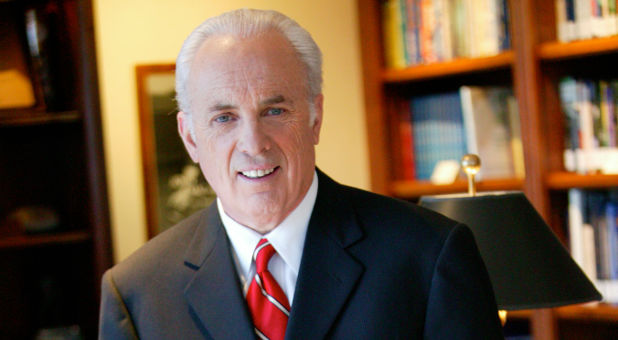
The Rev. John MacArthur, an influential and exacting evangelical preacher, died Monday at the age of 86.
He led Grace Community Church in the Los Angeles neighborhood of Sun Valley for more than five decades. His ministry announced his death on social media. On Sunday, Tom Patton, one of the church’s pastors, told the congregation MacArthur had been hospitalized with pneumonia.
MacArthur made news during the coronavirus pandemic for flouting Los Angeles County’s health orders by holding indoor services for hundreds of congregants and refusing to enforce masking and physical-distancing requirements.
Well before then, his influence had spread far beyond Southern California, where he grew up and took the helm of his nondenominational congregation at age 29.
His Grace to You broadcast ministry circulated his theologically conservative teachings while his many books, including the popular MacArthur Study Bible, were translated into dozens of languages.
“His legacy as a pastor and teacher in the faith will continue to inspire many generations to come,” said Jonathan Falwell, chancellor of Liberty University, where MacArthur had given the convocation address.
Dressed in a suit and tie, he eschewed pop culture references and emotional appeals from the pulpit, even as they became mainstays of modern evangelicalism.
His followers lauded him for his expository preaching, in which he walked them through Scripture line by line. He wanted his sermons to be timeless explanations of the Bible as he interpreted it.
“He could get more out of a Bible verse than anyone I’ve ever known,” evangelical leader Franklin Graham wrote on social media. He called MacArthur one of “America’s great Bible teachers.”
He was “a lion of the pulpit,” wrote the Rev. Al Mohler, a Southern Baptist leader, for the evangelical World magazine. “He was a preacher God used to make other preachers better preachers.”
MacArthur was unafraid to stir controversy for the sake of his beliefs, even deriding fellow evangelicals for what he saw as incorrect teachings and theology, including the growing charismatic wing of Christianity.


Francis Shepherfield
This article glorifies Rev. John MacArthur, but it’s important to recognize the troubling aspects of his ministry. His blatant disregard for public health during the pandemic raises ethical questions about his leadership and responsibility as a pastor. According to Pew Research, many Americans view religious leaders who prioritize personal beliefs over public health guidelines as irresponsible (Pew Research Center, 2020). Furthermore, MacArthur’s teachings have been criticized for their rigid interpretation of Scripture that aligns more with Gnostic theology than traditional Christian doctrine, which emphasizes faith and grace rather than strict adherence to law (Christianity.com). His tendency to dismiss other forms of worship and theology is not just controversial; it borders on heresy when he undermines the core tenets of Christianity that call for unity in diversity. This article fails to address these crucial points and instead presents a one-sided narrative that ignores the broader implications of MacArthur’s actions and teachings. In conclusion, the text can be seen as an attempt to romanticize a divisive figure whose legacy is marked by controversy rather than universal respect within the Christian community.
Troy Day
a multi mil preacher like Wagner @followers Philip Williams Neil Steven Lawrence and NOT from books and songs but property sales
Vijay Babu
Troy Day Greetings from India 🇮🇳
Neil Steven Lawrence
Troy Day Of course he was a solid and influential Gospel minister; and for his stand during the China Virus fake crisis should be commended. But of course he was virulently (no pun intended) against Pentecostal realities AND foolishly Calvinist–but many who lean toward Calvinism tend to be more geared toward reasoned argument than Holy Spirit inspired word. It is his loss for holding those two positions of error. Now that he’s in glory I’m sure he realizes the mistake he made for holding those blasphemous and heretical positions. As far as his real estate holdings, I see no problem with managing wealth–for Yahweh does promise his saints he will give them them power to gain wealth. (No prosperity preaching here–just solid Bible promises).
Troy Day
Neil Steven Lawrence YES tremendous prosperity wealth and properties which Philip Williams tried to sell to Peter Wagner
Philip Williams
Troy Day stop! Peter wanted to buy a farm, but I had none to sell him!
Philip Williams
Troy Day I thought my friend Richard Land wrote an honest and balanced obituary on Johnny Mac.
https://www.christianpost.com/voices/john-macarthur-most-influential-preacher-since-billy-graham.html
Troy Day
Philip Williams Id say John Mushenhouse posted his theological deviations most clearly so far
Troy Day
tell us more about these troubling aspects @Francis Shepherfield