Click to join the conversation with over 500,000 Pentecostal believers and scholars
| PentecostalTheology.com
Book Reviews / Pneuma 31 (2009) 105-160
139
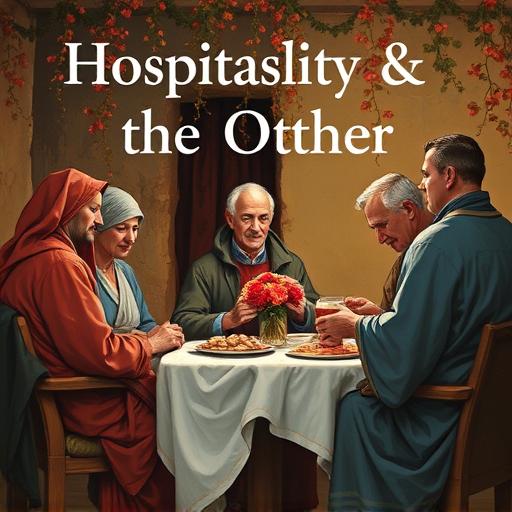
Amos Yong, Hospitality & The Other: Pentecost, Christian Practices, and the Neighbor (Maryknoll, New York: Orbis Books, 2008), 169 pp., paperback, $19.00.
With this utterly fascinating study Amos Yong adds to his voluminous publishing reper- toire in a manner that builds on his earlier pneumatic inter-religious works. Previously critiqued for being too abstract, Yong seeks to show how his Pneumatological-Trinitarian theological commitments manifest through a hands-on inter-religious approach of hospi- tality. After carefully arguing that doctrines and practices inform one another he shows how his theological maxim, “many tongues equal many practices,” not only is rooted in a biblical- patristic-theological interpretation of reality (or, following Yong, is it that interpretation primarily illocutionary for reality?) but how that maxim is sorely needed in our pluralistic, post-911, postmodern, post-Christian world. Put more simply, Yong believes the Holy Spirit seeks to shape (re. pathos) and empower (re. praxis) Christians to engage adherents within other religions with pneumatic imagination, pneumatic improvisation, and pneu- matic spontaneity: just as the Spirit did with Jesus himself.
Yong repeatedly argues that the Spirit’s coming on Pentecost in Acts 2 provides the arche- typal basis for a theology of inter-religious witness. I had expected that he would build on John 3:8, “the wind blows wherever it pleases . . . so it is . . . with the Spirit” to establish his inter-religious methodological approach. But Yong realizes that a pneumatic approach needs grounding not just soaring, feet not just wings, if it is going to function and abide in the “glocalized” (1) world in which we live. The day of Pentecost narrative, with its embod- ied verbal expressions and interpretations, makes room for both giving and receiving — and as it turns out in his conclusions — for both being hosts and being visitors.
In his third chapter Yong uniquely develops how the three traditional Christian theo- logical approaches to inter-religious dialogue have manifested in terms of their practices. The exclusivist approach (there is no salvation outside of Jesus Christ) results in the prac- tices of evangelism, apologetics, and an emphasis upon the visible church. The inclusivist approach (“Jesus might be the unique savior of humankind,” but in an inclusionary, not exclusionary, sense; the Spirit is the Spirit of creation and all creatures, so that the Spirit’s works in both the church and in the world share continuity; hence, “perhaps even religions are redeemable by the gospel . . .” [77-78]) results in a quest for social justice, and seeks both mutual enrichment and mutual transformation with members of other religions. The plu- ralist approach (each religion is true in its own way) seeks the practices of sustaining human inquiry, promoting human saintliness, fostering politico-economic liberation, variously promoting human goodwill, love, and compassion, and promoting a global consciousness. Yong’s intent is that instead of choosing the practices of one of these three Christian the- ologies of religion (though theologically he favors inclusivism), Christians ought be as diverse, as creative, and as spontaneous as is necessary for particular cultures and locations. More carefully, he proposes a “via media” based on pneumatic practices of hospitality — not theory — “through which there is the mutual transformation of religious traditions in ways that produce . . . a deepening of each tradition without abandonment of that tradition’s distinguishing characteristics,” (97).
Finally, in terms of summary, Yong follows Jean Daniélou and intriguingly suggests that Melchizedek may serve as a type for present day non-Christian (non-Jewish) religious
© Koninklijke Brill NV, Leiden, 2009 DOI: 10.1163/157007409X418347
1
140
Book Reviews / Pneuma 31 (2009) 105-160
believers. Before there was a law, before there was Judaism, Melchizedek hosted Abram and showed the latter hospitality. Yong wonders (117), could Melchizedek “have represented and foreshadowed how the religious longings and perhaps even beliefs and practices of all people are oriented toward God?” Melchizedek may even represent a biblical inclusivist type for inter-religious dialogue and practice.
Twenty-first century thinkers, pastors, missionaries and Christ-followers have much to learn from this study. Yong not only suggests but exemplifi es a heremeneutics of charity when it comes to how we read the “other,” whether Christian or not. He very carefully walks the reader through biblical, historical, and theological exegesis and argumentation. He evinces a painstaking level of research. He is right and even Trinitarian in approach to argue that we make “distance” for others to be authentically other. Every page is dense with rich information. As I read the book I was prodded to think carefully and then refl ect again still later. Nevertheless, there is critique that is warranted.
In pushing for practical (and theological-intellectual) hospitality Yong argues that Chris- tians should walk the razor’s edge of not falling into a “blurry syncretism” with other reli- gions and also of being open to how the encounter with others can bring about “conversion” (63, 103, 133) of all those involved. On the one hand he cautions that such encounters ought not “compromise Christian commitments,” but on the other hand he says such con- versions can enrich and transform Christians (82). Later he adds, “Christian mission is not only about bringing Christ to our neighbors of other faiths, but may also serve the impor- tant purpose of our meeting Christ in them,” (152).
For my part I have no doubt that careful, humble, and charitable encounters of and hospitality shared with adherents of other religions can produce insight and change within Christians; authentic personal encounter always produces change, especially when we encoun- ter the good, the true and the beautiful in/with others. But Yong pushes beyond that and wonders whether “people of other faiths [might] not only be instruments through which God’s revelation comes afresh to the people of God, but also perhaps be able to fulfi ll the requirements for inheriting eternal life ([Luke] 10:25) precisely through the hospitality that they show to their neighbors (which includes Christians)?” (103). I wonder, how is “con- version” diff erent from change?
It would be one thing to suggest that in our created nature human beings as imago dei are so potentially dynamic, so potentially eff ulgent, as to be capable of enrichment and growth through encounter and service. It is another — enormous — thing to suggest that the Holy Spirit is present in not only life-sustaining, but redemptive (78), ways apart from Christ. Yong’s inter-religious approach in this book blurs the categories of creation and redemption, and the pneumatological role within each. Had Yong built his model of mutual interreligious transformation on the basis of what it means to be created in God’s image, or if he had taken a more Reformed tack by choosing common grace as the means for inter- religious mutual tranformation, the theological crux would not be so grave. By pushing that the Spirit may well be at work in adherents of other religions Yong calls into question the very Trinitarian foundations that he seeks to build upon. Simply put, following the biblical narrative can one suggest that the Spirit is at work in redemptive ways apart from Christ or his gospel?
2
Book Reviews / Pneuma 31 (2009) 105-160
141
Let me press the point. I found myself wondering precisely about the “other” in Yong’s presentation. When Christians encounter the Holy Spirit in the hospitality of the adherents of other religions is that encounter because of or despite the other religions? Cultures, worldviews and religions are not simply ideated but indwelt and expressed by people in every day practice, as Yong rightly notes throughout the book. It follows then that it is critically important to clarify whether the Holy Spirit is indwelling those cultures/world- views/religions so that they become instruments of God’s revelation — in such a manner that the Spirit sanctions said culture/worldview/religion — or whether the Holy Spirit is present in and through them despite their being embedded in cultures/worldviews/reli- gions that are void of Christ and his gospel.
Tese criticisms aside, Yong continues to carefully probe and prod the inter-religious question. Any and all interested in the same endeavor will do well to learn from him.
Reviewed by Edmund J. Rybarczyk
3