Click to join the conversation with over 500,000 Pentecostal believers and scholars
| PentecostalTheology.com
Book Reviews / Pneuma 31 (2009) 105-160
159
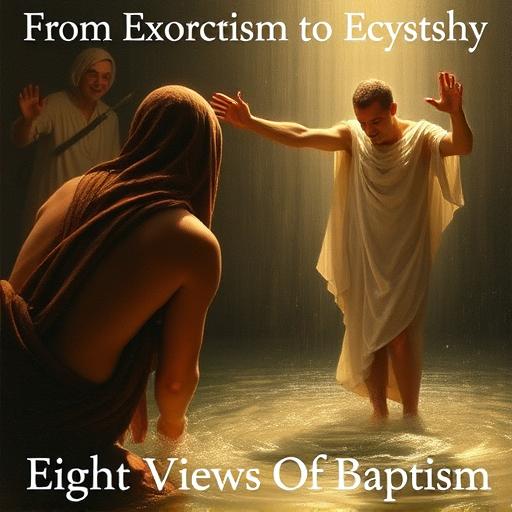
Russell Haitch, From Exorcism to Ecstasy: Eight Views of Baptism (Louisville: Westminster John Knox Press, 2007). xi + 185 pp. $22.95 paperback.
Russell Haitch, Assistant Professor of Christian Education at Bethany T eological Seminary (Indiana), explicates eight theological views of baptism stemming from diverse ecclesial backgrounds. The theologians whom he chose in this book include Alexander Schmemann, Martin Luther, John Calvin, T omas Aquinas, John Wesley, Karl Barth, John Howard Yoder, and Aimee Semple McPherson.
In chapter 1, Haitch analyzes Alexander Schmemann’s view of baptism, understood as literal death and resurrection with Jesus Christ (Romans 6:3-4). Schmemann, coming from the Orthodox tradition, elaborates on three defi nitions of death: 1) death of humanity — separation from God, 2) death of Jesus Christ which conquered spiritual death, and 3) death of baptism which a Christian undergoes during ritual baptism. Like many Classical Pente- costals, Schmemann distinguishes “baptism in water” from “baptism in the Holy Spirit,” although his defi nition of Spirit baptism diff ers from that of Classical Pentecostals. For Orthodox Christians, after water baptism, “baptism in the Holy Spirit” takes place normally on the same day. This Spirit baptism is also known as “chrismation,” which opens the door for theosis (deifi cation).
Chapter 2 elucidates John Howard Yoder’s view of baptism, namely, that baptism creates the new humanity of people who live in peace and unity. As it is stated in Galatians 3:27- 28, there is neither slave nor free, neither male nor female in this new humanity: people become one in Christ. Baptism brings about this new community that breaks down many kinds of barriers such as gender, race, and class.
Chapter 3 clarifi es T omas Aquinas’ view of baptism primarily as “the act of washing” (Eph. 5:25-26). According to Aquinas, the foremost eff ect of baptism is to “wash” away original sin as well as all of past personal sins. Construing baptism as a sacrament, it cleanses both one’s body and soul. Interestingly, Aquinas elaborates on three kinds of baptism: 1) of water, 2) of blood — Christian suff ering, and 3) of the Spirit (repentance).
Chapter 4 deals with Martin Luther’s view of baptism understood primarily as being into God’s Word with water (Mark 16:16). In baptismal water, God’s Word is enclosed, so baptism can become an external event to which a person can point in the face of serious doubts and anxieties regarding salvation. Furthermore, an authentic baptism requires a personal faith.
In chapter 5, Haitch analyzes John Calvin’s view that regards baptism as “sign and seal” like circumcision (Romans 4:11). Baptism is a sign from God to believers and a sign before other people that we belong to God’s family. Moreover, like a seal of a legal letter, it con- fi rms and gives assurance of God’s promise when a believer doubts.
Chapter 6 clarifi es John Wesley’s view of baptism that is overtly connected with the concept of regeneration. According to Wesley, John 3:5 speaks of baptism. Being born “of water” refers to “baptism in water,” but being born “of the Spirit” alludes to the new birth given by the Spirit, resulting in an authentic Christian life. For children, baptism (in water) causes regeneration; for adults, it may or may not cause regeneration based on the decision of a recipient.
© Koninklijke Brill NV, Leiden, 2009 DOI: 10.1163/157007409X418437
1
160
Book Reviews / Pneuma 31 (2009) 105-160
In Chapter 7, Haitch explicates Karl Barth’s view of baptism. Barth speaks of both bap- tism with the Holy Spirit and baptism with water. The two baptisms, which resemble the two natures of Jesus (divine and human), are correlated and yet distinguished. In under- standing Barth’s view of baptism, the key word is “freedom.” Human freedom is created with Spirit baptism, and water baptism is the first step, which a “freed” person can take.
Chapter 8 introduces the well-known Pentecostal preacher Aimee Semple McPherson. She thought about baptism as power based on Acts 1:5-8, in which the word “baptism” means “Spirit baptism,” not “water baptism.” She clearly separated water baptism from Spirit baptism, the latter accompanied by speaking in tongues.
The strengths of this book lie in its inclusion of eight theological perspectives, which are mutually illuminating and correcting, and the author’s clear writing style. The main weak- ness of this book lies in its lack of depth, perhaps the result of the author’s attempt to elucidate too many views in a short volume. Sometimes, Haitch over-simplifi es his discus- sion. For example, regarding Barth, Haitch should have underscored how Barth’s view of baptism went through at least three stages, i.e., shifting over time from a traditional Reformed position to a non-sacramentalist account (see John T ompson, The Holy Spirit in the T eology of Karl Barth [1991], and Koo Yun, Baptism in the Holy Spirit [2003]).
Overall, however, this is a solid work that lays out diverse and multiple meanings of “baptism,” congenial to the postmodern context. It is highly recommended for college and seminary students who desire to explore other diff erent views of baptism in an ecumenical framework.
Reviewed by Koo Dong Yun
2