Click to join the conversation with over 500,000 Pentecostal believers and scholars
| PentecostalTheology.com
 Practical application of Pentecostal theology in politics, economy and social issues


KENNETH E HAGIN PROPHECY – 1974 – Posted by Ray E Horton Prophecy by Kenneth E. Hagin on October 01, 1974 “No, the time…
RichardAnna Boyce
;
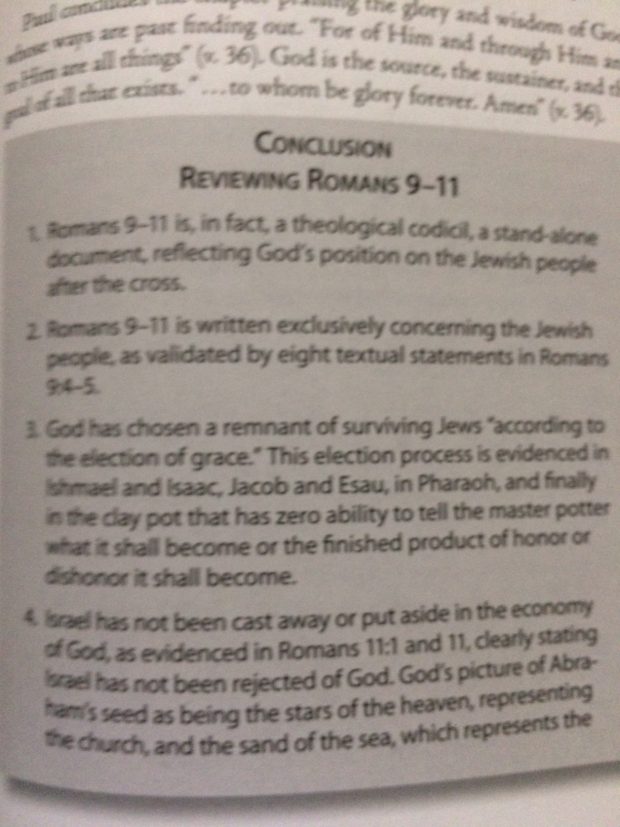
In chaps. 9-11 Paul deals with a question that may have arisen in the minds of his Christian Jewish and Gentile readers after reading 8:31-39. If God loves the elect (i.e., His chosen people, Israel) and His promises cannot be thwarted, how can He forget His chosen people and promises made to them in the OT?
Thus, Paul’s purpose of writing chaps. 9-11 is twofold. He seeks to vindicate God for temporarily excluding national Israel from His present plan in with the church, and to curb Gentile arrogance since Israel will be regrafted into God’s plan in the future. Paul’s answer covers God’s dealing with Israel’s past (chap 9:1-29), present (chap 9:30-10:21), and future (chap 11).
One should not understand the central issue in these chapters to be predestination, or even Israel’s justification-salvation (though he covers this as well). This section of Romans is about explaining how the promises of God in the Word have not failed (9:6 a). Although many Jews became believers, the majority did not (vv 1-5). And though God has temporarily set Israel aside, He has not nullified His promises to the nation (v 6 a). In light of the overall theme of Romans, this section explains why Israel is experiencing the wrath of God and what they can do to escape it.
RichardAnna Boyce
In 9:30-10:21, Paul switches from vindicating God’s sovereign use of Israel in the past for His purposes to His present setting aside of Israel due to her rejection of His righteousness. The term righteousness occurs eleven times in this section (9:30 [3 x], 31; 10:3 [3 x], 4-6,10). Accepting this righteousness resulting in justification would only be the beginning, not the end, for Israel to be delivered from God’s wrath. Full deliverance from temporal wrath comes only through obedience (10:9-21).
RichardAnna Boyce
Chapter 11 shows that even if Gentiles experience God’s mercy in the present, this is not to the exclusion of Israel’s permanent future deliverance. Thus, God’s wisdom, by extending mercy to all, vindicates Him because His original promises of the gospel to Israel (1:2; 10:15-16; 11:28) will be fulfilled literally in the future.
Varnel Watson
coming to a city near you Philip Williams