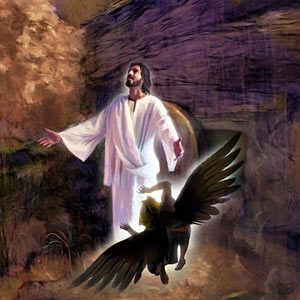
I’m always humbled when I think about Jesus
I’m always humbled when I think about what Jesus Christ did for me! Levi Allen Goff [10/03/2015 2:57 AM] Amen! That’s why I’m not…
If you don’t like Allah you aren’t going to like God!
The Gospel of John describes a scene where John the Baptist saw Jesus coming toward him and he made the following statement:
“Look, the Lamb of God, who takes away the sin of the world! This is
the one I meant when I said, ‘A man who comes after me has surpassed
me because he was before me.’ I myself did not know him, but the
reason I came baptizing with water was that he might be revealed to
Israel.” Then John gave this testimony: “I saw the Spirit come down
from heaven as a dove and remain on him. And I myself did not know
him, but the one who sent me to baptize with water told me, ‘The man
on whom you see the Spirit come down and remain is the one.” (John
1:29-34)
At first sight, it seems the writer was describing the actual baptism itself, as per Matthew’s account. However, the next few days finds Jesus choosing his disciples – not going into the wilderness as the Synoptics relate it. So, is this scene a ‘revisit’ so to speak? Is it Jesus coming out of the wilderness, walking past John, at about Passover season, some months following his actual baptism?
If so, then the Gospel of John is not recording the baptism event directly, but is recording John B’s testimony of that event. In other words, John B. sees Jesus returning, and calls out, “This is the man I baptised several months ago! This is the man the dove descended upon!”
So, is the Gospel of John recording the actual baptism event, or is he recording an occasion when Jesus revisited the same place on his way back from the wilderness? The latter explanation may reconcile some of the perceived differences between John and the Synoptic Gospels.
Is Jesus the ETERNAL Son of God?
If Jesus was the eternal son in the past, why didnt Satan recognize him. Why did he ask “if you are the son of…
Matthew 13:55 states:
Is not this the carpenter’s son? Is not his mother called Mary? And are not his brothers James and Joseph and Simon and Judas?
Mark 6:3 (ESV) states:
Is not this the carpenter, the son of Mary …
I was reading a neo pentecostal article… And it explored the questions: Is it possible to reject Jesus as Lord but accept him as…
Jesus had spent quite a bit of time speaking to his disciples about the coming of the Holy Spirit in John 14, 15, & 16. So, if the Holy Spirit was indeed imparted to the disciples when Jesus breathed on them in John 21, w…
Matthew 13:55 states:
Is not this the carpenter’s son? Is not his mother called Mary? And are not his brothers James and Joseph and Simon and Judas?
Mark 6:3 (ESV) states:
Is not this the carpenter, the son of Mary …
Did JESUS taste spiritual death in HELL? Where did Jesus complete his work of redemption? “Later, knowing that all was now completed, and so…
What is the opinion on Jesus’s use of the phrase “the eye of a needle” in Mark 10:25:
And Jesus looked around and said to his disciples, “How difficult it will be for those who have wealth to enter the kingdom of God!” And the disciples were amazed at his words. But Jesus said to them again, “Children, how difficult it is to enter the kingdom of God! It is easier for a camel to go through the eye of a needle than for a rich person to enter the kingdom of God.” And they were exceedingly astonished, and said to him, “Then who can be saved?”—Mark 10:23-26 (ESV)
Could it refer to the small gate which required a camel to unladen and cross through on its knees or could it be an extreme analogy?
And why did the Jews think Jesus was saying that he had seen Abraham when Jesus just spoke of Abraham seeing his day (and therefore him)?
John 8:56-57 (ESV)
56 Your father Abraham rejoiced that he would see my day. He saw it and was glad.”
57 So the Jews said to him, “You are not yet fifty years old, and have you seen Abraham?”
What is the logical progression here? Is there a translation issue?
I’m looking for how the Jews leaped to questioning that Jesus had seen Abraham rather than questioning how Abraham had seen this day. If you can show how they would be fine with the latter, you still need to solve why they think Jesus is claiming to have seen Abraham (and not the other way around). Or said differently, how did Abraham seeing Jesus’s day also mean or necessitate that Jesus had seen Abraham?
The main question remains how and/or when did Abraham see Jesus’ day, but I want to make sure your answer then informs our understanding of the Jew’s response.