
Click to join the conversation with over 500,000 Pentecostal believers and scholars
| PentecostalTheology.com
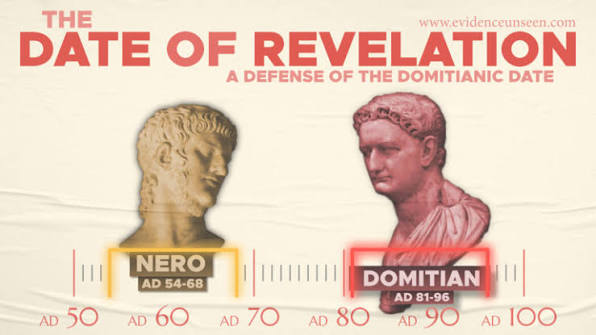
| # | Early Date (c. AD 64–69) | Late Date (c. AD 95–96) |
|---|---|---|
| 1. Temple imagery | Revelation 11:1–2 describes the temple as still standing, suggesting a date before AD 70. | The temple language can be interpreted symbolically, so it does not require a physical temple to still exist. |
| 2. Nero / 666 | Revelation 13:18’s 666 can correspond to Neron Caesar through Hebrew gematria, strongly supporting a first-century Nero context. | Nero’s name can be made to fit 666, but the identification depends on a particular spelling/transliteration; other interpretations are possible. |
| 3. Persecution | The persecution of Christians under Nero (AD 64–68) provides a natural historical setting for Revelation’s emphasis on persecution and martyrdom. | Revelation 2–3 describes persecution as occurring in a developed network of churches, and later tradition associates John’s exile with Domitian. |
| 4. “Soon” / “near” | Statements such as “the things which must shortly take place” (Rev. 1:1) and “the time is near” (1:3) naturally suggest imminent fulfillment. | “Soon” and “near” can refer to the beginning of an eschatological process rather than its complete fulfillment. |
| 5. Seven kings | Revelation 17:9–11 can potentially be interpreted through the succession of Roman emperors, with Nero playing a central role. This can produce an early-date chronology. | The emperor sequence is disputed, and different starting points produce different results; some chronological reconstructions fit better with the Domitianic period. |
| 6. Historical witness | Some early Christian traditions can be interpreted as preserving memories of Revelation’s composition before Jerusalem’s destruction. | Irenaeus explicitly says the Apocalypse was seen “toward the end of Domitian’s reign,” making AD 95–96 the strongest explicit external testimony for the late date. |
| 7. Jerusalem / Babylon | If “Babylon” represents Jerusalem, Revelation’s judgment imagery fits naturally with the approaching destruction of Jerusalem in AD 70. | If “Babylon” represents Rome, the book fits the late first-century confrontation between the church and the Roman imperial system, especially under Domitian. |
The strongest arguments on each side
Early date — strongest:
- Revelation 11 and the temple
- 666 = Nero
- Imminence language
- AD 70 / Jerusalem destruction as a possible fulfillment horizon
Late date — strongest:
- Irenaeus’s testimony
- The developed situation of the seven churches
- Domitianic persecution/exile tradition
- Rome/Babylon and the imperial context
The key issue
The debate really comes down to how much weight should be given to internal evidence versus external historical testimony.
The early-date case is strongest when Revelation is read as addressing the Jewish War, Nero’s persecution, and the destruction of Jerusalem in AD 70.
The late-date case is strongest when Revelation is read against the background of Domitian’s reign and the mature Roman imperial/church situation of the 90s, especially given Irenaeus’s explicit testimony.
One important qualification: “Nero = 666” is a significant argument for the early date, but it is not by itself decisive, because gematria depends on the precise form of the name being used.


Troy Day
@followers John Mushenhouse Philip Williams @highlight Jose Salinas The debate really comes down to how much weight should be given to internal evidence versus external historical testimony.
The early-date case is strongest when Revelation is read as addressing the Jewish War, Nero’s persecution, and the destruction of Jerusalem in AD 70.
The late-date case is strongest when Revelation is read against the background of Domitian’s reign and the mature Roman imperial/church situation of the 90s, especially given Irenaeus’s explicit testimony.
One important qualification: “Nero = 666” is a significant argument for the early date, but it is not by itself decisive, because gematria depends on the precise form of the name being used.
Jose Salinas
Troy Day From the perspective of DP, the identification of Nero as the referent for 666 is viewed as an example of the “already/not yet” tension in prophecy. While the sources acknowledge that Rome was the “current manifestation” of the Beast during the time of the writer, they argue that the identity of the Beast is not exhausted by any single first-century figure like Nero.
Troy Day
dp?
Jose Salinas
Troy Day Progressive Dispensationalism
Troy Day
Jose Salinas DP is some sort of baptistic oxymoron Philip Williams claims it was designed by Jesuit priests who defended his Pope so badly
Troy Day
Media: https://www.facebook.com/photo.php?fbid=2831336790584591&set=p.2831336790584591&type=3