
Click to join the conversation with over 500,000 Pentecostal believers and scholars
| PentecostalTheology.com
claim absolute authority, but leave room for
symbolism in futuristic elements; (3) understand historical context of prophetic
passages; (4) develop an eschatology in which the Holy Spirit has a prominent
role; (5) concentrate on our responsibility to the now, rather than what will
happen at the end; (6) relate the powers of the coming age to the revelation of
the Kingdom of God through the outpouring of the Holy Spirit; (7) present the
Book of Revelation as a message of hope; and (8) be careful not to be too
dogmatic about Scriptures that could be meant for future generations.³⁶
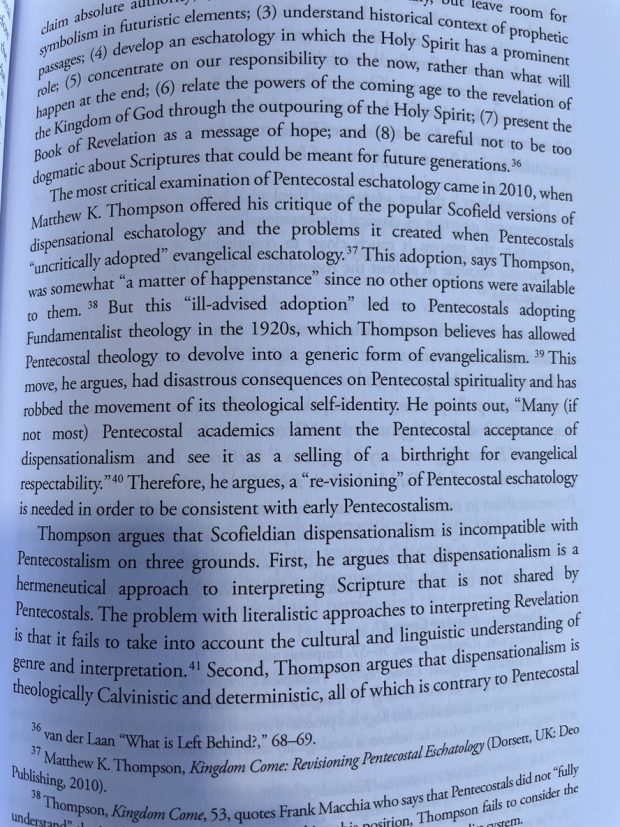
The most critical examination of Pentecostal eschatology came in 2010, when
Matthew K. Thompson offered his critique of the popular Scofield versions of
dispensational eschatology and the problems it created when Pentecostals
“uncritically adopted” evangelical eschatology.³⁷ This adoption, says Thompson,
was somewhat “a matter of happenstance” since no other options were available
to them.³⁸ But this “ill-advised adoption” led to Pentecostals adopting
Fundamentalist theology in the 1920s, which Thompson believes has allowed
Pentecostal theology to devolve into a generic form of evangelicalism.³⁹ This
move, he argues, had disastrous consequences on Pentecostal spirituality and has
robbed the movement of its theological self-identity. He points out, “Many (if
not most) Pentecostal academics lament the Pentecostal acceptance of
dispensationalism and see it as a selling of a birthright for evangelical
respectability.”⁴⁰ Therefore, he argues, a “re-visioning” of Pentecostal eschatology
is needed in order to be consistent with early Pentecostalism.
Thompson argues that Scofieldian dispensationalism is incompatible with
Pentecostalism on three grounds. First, he argues that dispensationalism is a
hermeneutical approach to interpreting Scripture that is not shared by
Pentecostals. The problem with literalistic approaches to interpreting Revelation
is that it fails to take into account the cultural and linguistic understanding of
genre and interpretation.⁴¹ Second, Thompson argues that dispensationalism is
theologically Calvinistic and deterministic, all of which is contrary to Pentecostal

Troy Day
this true? @followers John Mushenhouse Neil Steven Lawrence Philip Williams I know Jose Salinas is having trouble with this on + Jose Oscar Salinas Jr. and Oscar Valdez who left ion the grounds of accepting baptistic disp. The most critical examination of Pentecostal eschatology came in 2010, when
Matthew K. Thompson offered his critique of the popular Scofield versions of
dispensational eschatology and the problems it created when Pentecostals
“uncritically adopted” evangelical eschatology.³⁷ This adoption, says Thompson,
was somewhat “a matter of happenstance” since no other options were available
to them.³⁸ But this “ill-advised adoption” led to Pentecostals adopting
Fundamentalist theology in the 1920s, which Thompson believes has allowed
Pentecostal theology to devolve into a generic form of evangelicalism.³⁹ This
move, he argues, had disastrous consequences on Pentecostal spirituality and has
robbed the movement of its theological self-identity. He points out, “Many (if
not most) Pentecostal academics lament the Pentecostal acceptance of
dispensationalism and see it as a selling of a birthright for evangelical
respectability.
Howard Gardner
Of course it is incompatible. Aside from being a Dead-beat-Daddy, a counterfeiter, an adulterer and even an accused rapist, Scofield was a cessationist on a par with Carl McIntyre and John MacArthur. And I should mention that each borrowed from the Manichean Gnostics indirectly from Augustine.
Troy Day
Howard Gardner as you are unable to prove ANY of these accusations – even cessationist is FAR fetched… but that AG denied him in 1920s is a new thing
Troy Day
Howard Gardner Do you mean C. I. Scofield (the Bible-reference editor associated with dispensationalism, often called “Scofieldian”)? If so, I can’t find reliable evidence that he was accused of rape.
There are historical allegations and documentation concerning Cyrus Ingerson Scofield’s legal and personal controversies—including abandonment of family, alleged financial misconduct, and a reported late-19th-century forgery arrest—but those are separate matters and should not be conflated with sexual-assault allegations.
John Mushenhouse
Troy Day perhaps he is confusing Scofield with Dake. he did go awol from the confederate army.
Jose Salinas
Troy Day Progressive Dispensationalism is compatible 😎
Pentecostal Theology
Jose Salinas no not really AT LEAST not as far as AG has been concerned since 2010 John Mushenhouse
George Hartwell
Dispensationalism! Holy Spirit only active in part of history? God took a few thousand years off?
Troy Day
WOULD like to point out again Jose Salinas THAT as Philip Williams has informed Scofield was anti-pentecostal anti-apostolic anti-gifts in his own way largely advised by pre-trib Jesuits sent by the pope to steal over the Americas from the protestants FACT b/c of which Oscar Valdez LEFT when John Mushenhouse checked him for being baptist
Troy Day
tell us ALL about it George Hartwell
Troy Day
BTW Jose Salinas EVEN William DeArteaga defeated this!